Zacatecas
From the turquoise traders of Chalchihuites to the silver city founded in 1546 and the battle of 1914, Zacatecas has fed Mexico's wealth and sent its people to the USA.
Capital: Zacatecas · Became a state: 1823 · Checked 3 Nov 2026
Interactive maptap or click a state to open its page
Zacatecas in figures from its history
Turquoise, hill towns and the Gran Chichimeca
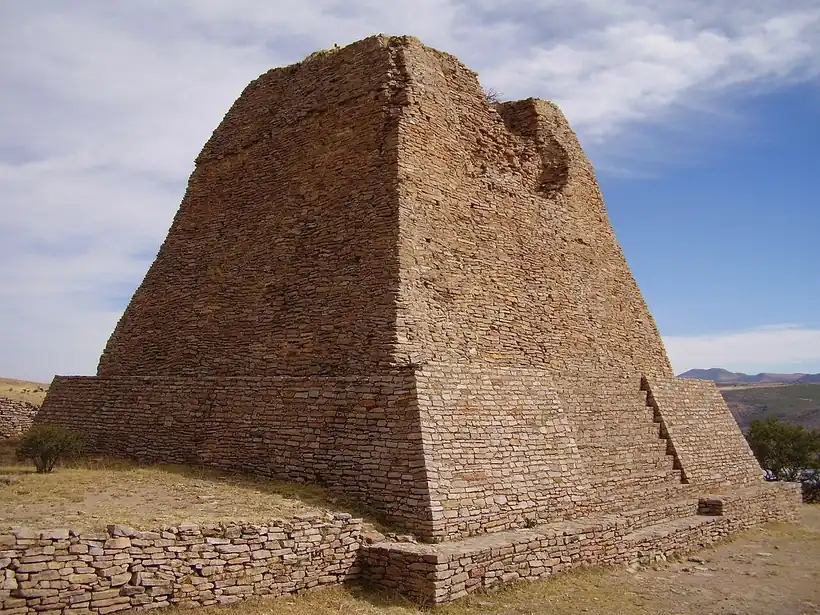
Long before the Spanish arrived, the south and west of what is now Zacatecas formed the northern edge of Mesoamerica. The Chalchihuites culture flourished here from about 200 to 900 CE, with its peak between 700 and 900. Its people mined turquoise, worked it and traded it far beyond the region. At Alta Vista, close to the Tropic of Cancer, they built a ceremonial centre laid out to the cardinal points and dedicated to the Sun. Further south, La Quemada rose on a fortified hill between about 300 and 1200 CE, with a hall of columns, a ball court and roads that ran for more than 170 km. It was later burned and abandoned, and its builders are still debated.
Indigenous languages spoken today
Speakers aged 3 and over, census of 2020 13
Zacatecas has very few speakers of Indigenous languages: 5,005 people aged 3 and over in the 2020 census, 0.3% of that population. The counts by language come from the census's extended sample, which estimates 4,820 speakers in all.

The dry plateau to the north belonged to Aridoamerica, the country of hunting and gathering peoples. The Mexica never conquered it and called it the Gran Chichimeca. When the Spanish came, the main groups were the Caxcanes in the south, the Zacatecos, who gave their name to the city and the state, and the Guachichiles. At El Teúl, a hilltop town occupied from about 200 CE, life went on until the Spanish destroyed it in 1531. In 2020 about 5,000 people aged 3 and over spoke an Indigenous language in Zacatecas, mostly Huichol, Southern Tepehuan and Nahuatl.
The silver city and the road south
The first Spanish settlement inside today's borders was founded in 1531 near Nochistlán. The Caxcanes, pressed for tribute and labour under the encomienda, the grant of Indigenous towns' tribute and work to Spanish settlers, answered with the Mixtón War of 1540 to 1542, led by Tenamaztle of Nochistlán. Viceroy Antonio de Mendoza crushed it, and the survivors were enslaved or sent to farms and mines. On 8 Sep 1546 Juan de Tolosa, guided by an Indigenous man, came down from the hill of La Bufa with silver ore. Diego de Ibarra, Baltasar Temiño de Bañuelos and others followed, backed by Cristóbal de Oñate, and a mining camp was formally set up in 1548. The silver road to Mexico City soon drew the attacks of the Chichimeca War, which ended only when the viceroys bought peace with goods and land around 1590.
Interactive maptap or click a state to open its page
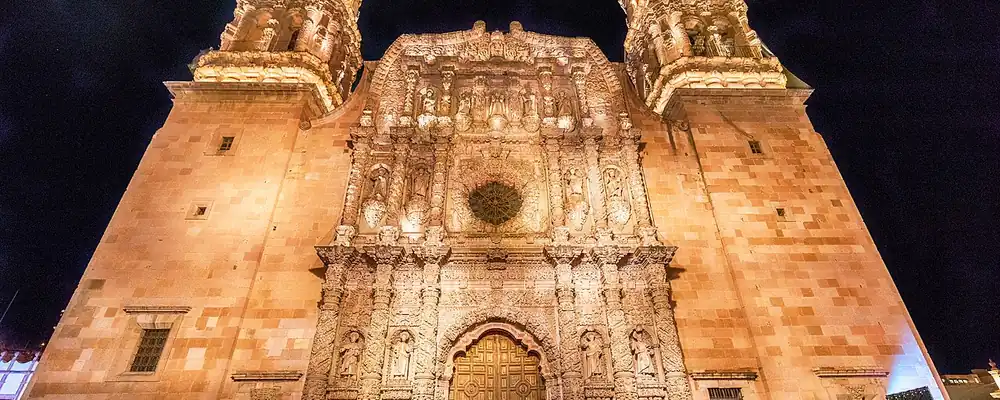
Zacatecas became one of the wealthiest towns in New Spain. Philip II named it a city in 1585 and granted its arms in 1588, and the Franciscans made it a base for missions further north. A second boom came in the 18th century, when the region is said to have produced about a fifth of the world's silver. That wealth paid for the cathedral, begun in 1729 and opened in 1752. The heaviest work fell on Indigenous labourers, among them captives of the frontier wars, and slavery lasted in the territory until the state abolished it in 1826.
Places in its history
Zacatecas
City · 1546
The silver city, founded below La Bufa after the strike of 1546; World Heritage since 1993. 4
La Quemada
Archaeological site · c. 300-1200 CE
Fortified hill city with a hall of columns and a road network of more than 170 km. 5
Alta Vista
Archaeological site · c. 400-900 CE
Chalchihuites ceremonial centre near the Tropic of Cancer, dedicated to the Sun. 10
El Teúl
Archaeological site · c. 200-1531
Hilltop town occupied for some 13 centuries until the Spanish destroyed it in 1531. 1
Nochistlán
Battlefield · 1531-41
Site of the first Spanish settlement in the territory and home of Tenamaztle; taken by Mendoza on 9 Nov 1541. 7
Fresnillo (Proaño)
Mine · 1554
Reached by Francisco de Ibarra in 1554; its Proaño mines were revived around 1828. 9
Federalism, reform and the taking of Zacatecas
News of Hidalgo's rising reached the city on 21 Sep 1810, and insurgent forces passed through the territory twice during the war. Independence was sworn in Zacatecas on 5 Jul 1821. The state was declared free on 18 Oct 1823 and, under governor Francisco García Salinas, became a stronghold of federalism, the cause of strong, self-governing states against the centre. Between 1824 and 1825 it set up its first press, treasury, high court and constitution, opened a teachers' college in 1826 and put the old Proaño mines at Fresnillo back to work around 1828. In the Reform years, when liberal laws sold off Church and communal lands, the liberal Jesús González Ortega took control of the state in 1859, and French troops held it for about two years during the French Intervention.
1810 to 1920 in Zacatecas
From the timeline below, coloured by era
- 1810News of Hidalgo's rising reaches Zacatecas on 21 Sep. 3
- 1823Zacatecas is declared a free and federated state on 18 Oct. 2
- 1826The state abolishes slavery and opens its first teachers' college. 3
- 1884The first train reaches Zacatecas, with electricity, telephone and telegraph. 3
- 1914On 23 Jun the División del Norte takes the city in the bloodiest battle of the campaign against Huerta. 6
In the Porfiriato, Porfirio Díaz's rule from 1876 to 1911, the railway arrived in 1884, along with electric light, the telephone and the telegraph, and by the end of the century silver again supplied about 60% of the state's export revenue. On 23 Jun 1914 Pancho Villa's División del Norte stormed the city, with Felipe Ángeles planning the attack and directing the artillery. Federal losses were put at 6,000 to 7,000 dead, and the battle effectively ended the old federal army; Victoriano Huerta resigned on 15 Jul. The capital has carried the title of Heroica Ciudad ever since. After the battle Zacatecans divided between Carrancistas and Villistas, the followers of the rival Revolutionary leaders Venustiano Carranza and Pancho Villa, until the Carrancistas took firm control of the state government.
Dry fields, long journeys and a World Heritage city
In the 20th century Zacatecas remained a mining state, while its farmland, dry and mostly without irrigation, could not hold its young people. Emigration, already visible in the late 19th century, became the defining fact of the century. In 1956, 1957 and 1958, Zacatecans made up 9.7%, 11.1% and 10.4% of all Mexican emigration. Across the century, 6.1% of the 9.2 million Mexicans who went to the USA came from this one state, and between 1990 and 1995 about 26,000 people a year left. Zacatecas became part of what geographers called Mexico's hollow core, a region emptied by departures to the capital, the border and the north.
The region, c. 1600 and today
What each state turned on, by the era table below; Zacatecas outlined in gold.
Interactive maptap or click a state to open its page
c. 1600
Zacatecas: Silver mining districts
- Silver mining districts
- Towns, farms and workshops of the old heartland
- Ports, sugar and cacao
- Frontier: missions, presidios, independent peoples
Today
Zacatecas: Mining
- Export manufacturing
- Oil and gas
- Tourism
- Farming and agro-exports
- Mining
- Ports and logistics
- Services and government
The census shows the cost. The state counted 462,190 people in 1900 and only 459,047 in 1930, after the revolutionary years, and it took the rest of the century and beyond to more than triple. The Universidad Autónoma de Zacatecas opened in 1968. In 1993 UNESCO listed the historic centre of the capital as World Heritage, and the El Edén mine, worked from 1586 until 1960, reopened to visitors in 1975. A major highway expansion ran from 1998 to 2004, tying the old silver road to the modern network.
In the north-east of the state, near Concepción del Oro, the Peñasquito mine began production in 2008 and was formally inaugurated in 2010, an open pit for gold, silver, lead and zinc. Migration reshaped public works. A scheme born in Zacatecas in 1992, in which governments added 2 dollars for every dollar sent by hometown clubs in the USA, and 3 from 1999, became the federal Tres por Uno programme in 2002, paying for basic works in the villages the migrants had left. The silver that founded the state and the journeys to the USA that emptied it still frame its life.
Zacatecas, date by date
Before the Spanish before 1519
The colonial centuries 1519 to 1809
- 1531
The Spanish found their first settlement in the territory near Nochistlán and destroy the hill town of El Teúl. 1
- 1540-42
The Caxcanes rise in the Mixtón War, crushed by Viceroy Antonio de Mendoza. 7
- 1546
On 8 Sep Juan de Tolosa brings silver ore down from La Bufa, and the rush begins. 3
- 1548
The mining camp is formally established as Minas de Nuestra Señora de los Remedios. 4
- c. 1550-90
The Chichimeca War is fought over the silver road until peace is bought with goods and land. 8
- 1585
Philip II grants the title of Ciudad de Nuestra Señora de los Zacatecas. 3
- 1729
Work begins on the cathedral, paid for by the second silver boom; it opens for worship in 1752. 4
Independence and the Reform 1810 to 1875
The Porfiriato 1876 to 1910
- 1884
The first train reaches Zacatecas, with electricity, telephone and telegraph. 3
The Revolution 1910 to 1920
- 1914
On 23 Jun the División del Norte takes the city in the bloodiest battle of the campaign against Huerta. 6
Modern Mexico after 1920
- 1956-58
Zacatecans make up about a tenth of all Mexican emigrants each year. 2
- 1993
UNESCO lists the historic centre of the capital as World Heritage. 4
- 2002
The Tres por Uno programme, born in Zacatecas in 1992 to match migrants' remittances for public works, becomes federal. 18
- 2008-10
The Peñasquito open-pit mine begins production in the north-east of the state. 17
Where Zacatecas stood: c. 1600, 1910 and today
Interactive maptap or click a state to open its page
c. 1600
Silver, the heartland and the frontier
Zacatecas: Silver mining districts
- Silver mining districts
- Towns, farms and workshops of the old heartland
- Ports, sugar and cacao
- Indigenous south: cochineal, maize, tribute
- Maya lands under encomienda or beyond Spanish rule
- Frontier: missions, presidios, independent peoples
1910
The Porfiriato at its height
Zacatecas: Mining
- Mining
- Oil
- Henequén
- Sugar and textile mills
- Haciendas: grain, pulque, cattle
- Export crops: coffee, tobacco, cacao, chicle, timber
- Steel, cotton and the railway north
- Ranching frontier
- The national capital
Today
What each state turns on now
Zacatecas: Mining
- Export manufacturing
- Oil and gas
- Tourism
- Farming and agro-exports
- Mining
- Ports and logistics
- Services and government
Why Mexico's own reading of what each state's economy turned on in that period, drawn from the sources listed in each state's room; a classification, not a measurement.
Today's numbers for Zacatecas
Output, exports, jobs, wages and investment now, each with its source and date.
The bookBook 6, Where to Go in Mexico, chapter 15
Where to Go in Mexico: The Bajío and Center-North, the corridor this state belongs to.
Why MexicoThe national timeline
The turning points of the whole country, each dated, each with its source.
Sources, each with its date
- Wikipedia (English), Zacatecas, History and Demographics sections, 3 Nov 2026 · read 3 Nov 2026 · link
- Wikipedia (Spanish), Zacatecas, 3 Nov 2026 · read 3 Nov 2026 · link
- Wikipedia (Spanish), Historia de Zacatecas (draws on Breve Historia de Zacatecas), 3 Nov 2026 · read 3 Nov 2026 · link
- Wikipedia (English), Zacatecas City, 3 Nov 2026 · read 3 Nov 2026 · link
- Wikipedia (English), La Quemada, 3 Nov 2026 · read 3 Nov 2026 · link
- Wikipedia (English), Battle of Zacatecas (1914), 3 Nov 2026 · read 3 Nov 2026 · link
- Wikipedia (English), Mixtón War, 3 Nov 2026 · read 3 Nov 2026 · link
- Wikipedia (English), Chichimeca War, 3 Nov 2026 · read 3 Nov 2026 · link
- Wikipedia (Spanish), Fresnillo, 3 Nov 2026 · read 3 Nov 2026 · link
- INAH, Foto del día: Alta Vista, un centro ceremonial solar en Zacatecas, 1 Jul 2024 · read 3 Nov 2026 · link
- SEP, Nueva Escuela Mexicana, Las culturas del Norte: Chalchihuites, 6 Feb 2025 · read 3 Nov 2026 · link
- INEGI, Censo de Población y Vivienda 2020, press release 57/21 for Zacatecas, 26 Jan 2021 · read 3 Nov 2026 · link
- Data México (Secretaría de Economía), Zacatecas profile, Indigenous languages from the 2020 census extended sample, 3 Nov 2026 · read 3 Nov 2026 · link
- Tercer Censo de Población de los Estados Unidos Mexicanos (1910), table VI, population by entity in 1895, 1900 and 1910 (Universidad Veracruzana digital edition), 1910 · read 3 Nov 2026 · link
- Encyclopaedia Britannica, Zacatecas (state), 9 Sep 2026 · read 3 Nov 2026 · link
- GeoNames gazetteer, coordinates for the map pins, 3 Nov 2026 · read 3 Nov 2026 · link
- Mining Technology, 'Peñasquito Gold Mine, Zacatecas, Mexico' (30 Apr 2014, updated 13 Feb 2020), 13 Feb 2020 · read 3 Nov 2026 · link
- Rodolfo García Zamora, 'El Programa Tres por Uno de remesas colectivas en México. Lecciones y desafíos', Migraciones Internacionales 4 (1), Jan-Jun 2007, 2007 · read 3 Nov 2026 · link
Pictures
- Fachada Frontal de la Catedral de Zacatecas, Zac: Martín Daniel Cordero Amézquita, CC BY-SA 3.0, Wikimedia Commons · read 3 Nov 2026
- Votive Pyramid La Quemada: Pablo A. Haya, CC BY-SA 3.0, Wikimedia Commons · read 3 Nov 2026

Where the sources disagree
- Statehood: Wikipedia (Spanish) gives 18 Oct 1823; Wikipedia (English) gives 23 Dec 1823. This page uses 18 Oct 1823.
- City title: Wikipedia (Spanish) gives a royal decree of 1585; Wikipedia (English, state article) gives 1586. This page uses 1585.
- La Quemada: its own Wikipedia article dates it c. 300-1200 CE; the state article gives 500-900 CE. This page uses 300-1200.
Yucatán
From Izamal, Uxmal and Chichén Itzá to Spanish Mérida, the Caste War and the henequen fortune, Yucatán is the Maya north that never stopped speaking Maya.
All 32 on the mapNext →Aguascalientes
Chichimeca hunting grounds became a rest stop on the silver road, then a state carved from Zacatecas, a railway town and, from 1982, a car-making valley.