Aguascalientes
Chichimeca hunting grounds became a rest stop on the silver road, then a state carved from Zacatecas, a railway town and, from 1982, a car-making valley.
Capital: Aguascalientes · Became a state: 1857 · Checked 3 Nov 2026
Interactive maptap or click a state to open its page
Aguascalientes in figures from its history
Painted rocks and the peoples of the Gran Chichimeca
People lived in the valleys of Aguascalientes long before any written record. Rock paintings, potsherds and projectile points survive in the caves of the Sierra del Laurel and at sites such as El Tepozán, near Calvillo, and El Ocote, in the south-west of the state. A survey by the archaeologist Daniel Valencia recorded 8 rock-art sites. At El Ocote the paintings seem to belong to the same people who lived on the hill, but no firm dates have been published for any of them.
Indigenous languages spoken today
Speakers aged 3 and over, census of 2020 11
Aguascalientes has very few speakers of Indigenous languages: 2,539 people aged 3 and over in the 2020 census, 0.2% of that population. The counts by language come from the census's extended sample, which estimates about 2,790 speakers in all.

From about the 12th century, groups from the north moved into the region. The Spanish later called them Chichimecas, a word that described a way of life more than a single nation. Among them were the Guachichiles, Guamares, Caxcanes, Tecuexes and Zacatecos. They hunted, gathered and moved with the seasons, and they defended their land hard. In 1546, when Spanish raids began, the region held about 8,500 Indigenous people, most of them Guamares. Their languages have not survived. The 2,539 speakers counted in 2020 speak mainly Nahuatl, Mazahua and Totonac, tongues of central and eastern Mexico.
Presidios, hot springs and the silver road
The first Spaniard to enter the territory was Pedro Almíndez Chirino, sent by Nuño de Guzmán, in late 1530 or early 1531. The land mattered because of what lay to the north. After the silver strikes at Zacatecas, convoys carried bullion south along the Camino de la Plata to Mexico City, and Chichimeca resistance made the road dangerous. Around 1570 the viceroy Martín Enríquez de Almansa had presidios, small fortified garrisons, built at Las Bocas, Palmillas and Ciénega Grande to guard it. Felipe II then asked for a man of means to settle the valley. Juan de Montoro and 11 companions founded the villa on 22 Oct 1575. First called San Marcos, it took the name of Our Lady of the Assumption of the Hot Waters on 18 Aug 1611, after the springs that still give the state its name.
Interactive maptap or click a state to open its page
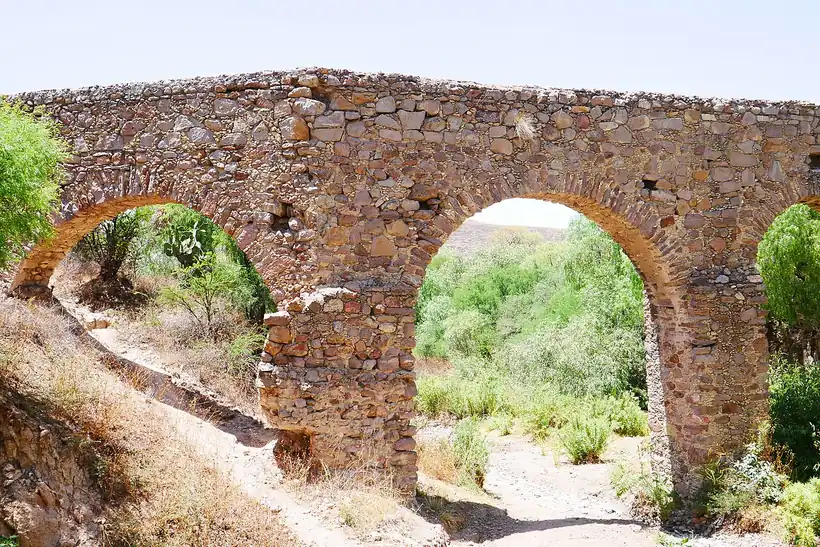
For most of the colonial era the town belonged to Nueva Galicia, the kingdom ruled from Guadalajara. Its haciendas, the great rural estates, raised crops and livestock, and travellers on the silver road rested there. Small mining towns grew up in the north, at Asientos and Tepezalá, where the Franciscan convent of El Tepozán dates from 1620. In 1786 Aguascalientes became a sub-delegation, a district within one of the new Bourbon provinces called intendancies, and from 24 Apr 1789 it answered to Zacatecas.
Places in its history
Aguascalientes
City · 1575
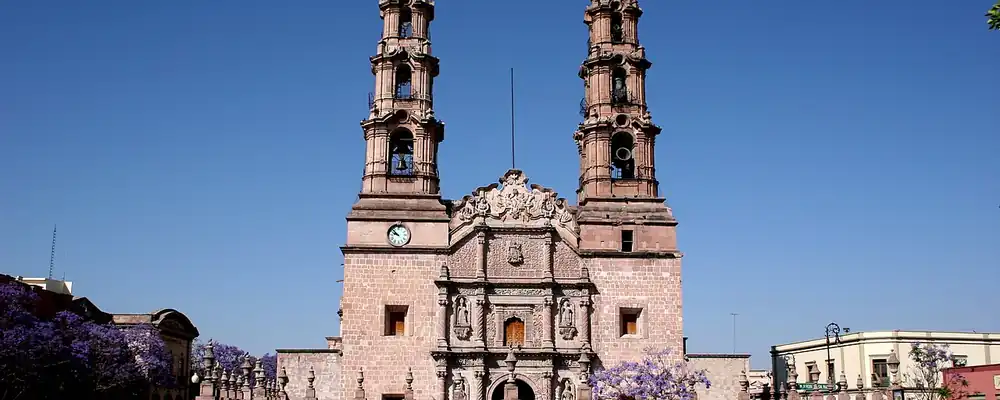
Founded in 1575 as a rest stop on the silver road; state capital since 1857 and railway city from 1884. 3
El Ocote rock paintings
Archaeological site · Undated
Rock shelters with paintings on the hill of Los Tecuanes, near the village of El Ocote. 14
Real de Asientos
Mine · 1620
Old mining town with the Franciscan convent of El Tepozán, founded 1620. 8
Hacienda de San Blas, Pabellón de Hidalgo
Hacienda · 1811
Where Hidalgo lost his military command in 1811; now the Museum of the Insurgency, opened 1967. 7
Breaking from Zacatecas, and the Convention of 1914
After the insurgent defeat at Puente de Calderón in Jan 1811, Miguel Hidalgo's column reached the Hacienda de San Blas at Pabellón, where his fellow leaders, blaming him for the defeat, stripped him of military command. Independence left Aguascalientes inside Zacatecas, and the town spent 2 decades trying to leave. In 1835, after Zacatecas resisted a federal law cutting state militias, Antonio López de Santa Anna defeated its governor, Francisco García Salinas, on 11 May. A decree of 23 May 1835 separated Aguascalientes as a territory. Local memory credits a dinner and a kiss from María Luisa Fernández de García Rojas, but that is legend. The status was contested for years, and only the Constitution of 1857 made Aguascalientes a state, approved unanimously by the 79 deputies present on 10 Dec 1856.
1810 to 1920 in Aguascalientes
From the timeline below, coloured by era
- 1811At the Hacienda de San Blas in Pabellón, Hidalgo is stripped of military command after Puente de Calderón. 7
- 1828The first San Marcos Fair is held, 5-20 Nov, to show the region's produce and livestock. 5
- 1835A decree of 23 May 1835 separates Aguascalientes from Zacatecas as a territory. 2
- 1857The Constitution of 1857, in force from 16 Sep, confirms Aguascalientes as a state. 2
- c. 1884The first passenger train of the Mexican Central Railway reaches the city. 2
- 1894Construction begins on the Guggenheim smelter, the Gran Fundición Central Mexicana. 12
- 1897-1903The Mexican Central builds its general workshops on land taken from the Hacienda de Ojocaliente. 13
- 1914The revolutionary Convention meets at the Morelos Theatre, 10 Oct to 9 Nov. 4
The railway, a hallmark of the Porfiriato (Porfirio Díaz's rule, 1876-1911), transformed the town. The first passenger train of the Mexican Central arrived around 1884. In 1894 Salomon Guggenheim's Gran Fundición Central Mexicana began building its smelter on the San Pedro river, and in 1897 the Mexican Central chose the city for its general workshops, finished in 1903. During the Revolution the Morelos Theatre hosted the Convention of 1914, where the victorious Revolutionary factions, the Carrancistas, Villistas and Zapatistas (followers of Carranza, Villa and Zapata), tried to agree on a government. It met from 10 Oct to 9 Nov and named Eulalio Gutiérrez provisional president.
Irrigation, rail yards and the car plants
The smelter closed in 1925 as mining in the region declined, but the railway workshops kept the capital a working town. The countryside changed with water. The Presa Calles, begun in 1927 and opened in 1928 on the Santiago river at San José de Gracia, was titled Irrigation System No. 1. It holds up to 340 million m³ and serves about 2,000 users across more than 4,000 ha, and the irrigation district built around it, district 001 Pabellón, became one of the first large public irrigation schemes in Mexico. The San Marcos Fair, held since 1828, was raised to national status in 1958.
The region, c. 1600 and today
What each state turned on, by the era table below; Aguascalientes outlined in gold.
Interactive maptap or click a state to open its page
c. 1600
Aguascalientes: Towns, farms and workshops of the old heartland
- Silver mining districts
- Towns, farms and workshops of the old heartland
Today
Aguascalientes: Export manufacturing
- Export manufacturing
- Mining
A new wave of growth began in the 1980s, driven by textiles, cars and electronics. Nissan opened its first plant in Aguascalientes in 1982, and the state became one of the country's car-making centres. INEGI, the national statistics institute, was created on 25 Jan 1983 and has had its headquarters in the capital since 1985. Two new municipalities followed the growth, San Francisco de los Romo in 1991 and El Llano in 1992. The former mining towns of Asientos and Tepezalá, by contrast, emptied out.
In Nov 2013 Nissan opened a second manufacturing complex, Aguascalientes A2, and on 3 Sep 2015 Daimler and the Renault-Nissan Alliance broke ground on COMPAS, a joint plant built to make compact cars for Mercedes-Benz and Infiniti, It began operating in 2017, and in Oct 2025 Nissan and Daimler told suppliers it would close on 31 May 2026. The old railway-workshop town became a town of assembly lines. Aguascalientes has served the traffic between the centre and the north since the silver convoys of the 1570s, and the same road now carries trucks loaded with new cars.
Aguascalientes, date by date
Before the Spanish before 1519
- 12th century
Hunting and gathering peoples from the north, later called Chichimecas, settle the region. 2
The colonial centuries 1519 to 1809
- 1530-31
Pedro Almíndez Chirino, under Nuño de Guzmán, is the first Spaniard to enter the territory. 2
- 1546
About 8,500 Indigenous people, mostly Guamares, live in the region as Spanish raids begin. 2
- c. 1570
Presidios at Las Bocas, Palmillas and Ciénega Grande guard the silver road from Zacatecas. 2
- 1575
Juan de Montoro founds the villa on 22 Oct 1575. 2
- 1789
Aguascalientes is placed under the intendancy of Zacatecas on 24 Apr 1789. 2
Independence and the Reform 1810 to 1875
- 1811
At the Hacienda de San Blas in Pabellón, Hidalgo is stripped of military command after Puente de Calderón. 7
- 1828
The first San Marcos Fair is held, 5-20 Nov, to show the region's produce and livestock. 5
- 1835
A decree of 23 May 1835 separates Aguascalientes from Zacatecas as a territory. 2
- 1857
The Constitution of 1857, in force from 16 Sep, confirms Aguascalientes as a state. 2
The Porfiriato 1876 to 1910
The Revolution 1910 to 1920
- 1914
The revolutionary Convention meets at the Morelos Theatre, 10 Oct to 9 Nov. 4
Modern Mexico after 1920
- 1927-28
The Presa Calles is built as Irrigation System No. 1. 6
- 1982
Nissan opens its first plant in Aguascalientes. 16
- 1985
INEGI, created in 1983, moves its headquarters to the city of Aguascalientes. 2
- 2013
Nissan opens its second complex in the state, Aguascalientes A2, in Nov. 18
- 2015
Daimler and the Renault-Nissan Alliance break ground on the COMPAS plant on 3 Sep. 18
Where Aguascalientes stood: c. 1600, 1910 and today
Interactive maptap or click a state to open its page
c. 1600
Silver, the heartland and the frontier
Aguascalientes: Towns, farms and workshops of the old heartland
- Silver mining districts
- Towns, farms and workshops of the old heartland
- Ports, sugar and cacao
- Indigenous south: cochineal, maize, tribute
- Maya lands under encomienda or beyond Spanish rule
- Frontier: missions, presidios, independent peoples
1910
The Porfiriato at its height
Aguascalientes: Haciendas: grain, pulque, cattle
- Mining
- Oil
- Henequén
- Sugar and textile mills
- Haciendas: grain, pulque, cattle
- Export crops: coffee, tobacco, cacao, chicle, timber
- Steel, cotton and the railway north
- Ranching frontier
- The national capital
Today
What each state turns on now
Aguascalientes: Export manufacturing
- Export manufacturing
- Oil and gas
- Tourism
- Farming and agro-exports
- Mining
- Ports and logistics
- Services and government
Why Mexico's own reading of what each state's economy turned on in that period, drawn from the sources listed in each state's room; a classification, not a measurement.
Today's numbers for Aguascalientes
Output, exports, jobs, wages and investment now, each with its source and date.
The bookBook 6, Where to Go in Mexico, chapter 15
Where to Go in Mexico: The Bajío and Center-North, the corridor this state belongs to.
Why MexicoThe national timeline
The turning points of the whole country, each dated, each with its source.
Sources, each with its date
- Wikipedia (English), Aguascalientes, History section, 3 Nov 2026 · read 3 Nov 2026 · link
- Wikipedia (Spanish), Aguascalientes, Historia section, 3 Nov 2026 · read 3 Nov 2026 · link
- Wikipedia (English), Aguascalientes City, 3 Nov 2026 · read 3 Nov 2026 · link
- Wikipedia (English), Convention of Aguascalientes, 3 Nov 2026 · read 3 Nov 2026 · link
- Wikipedia (English), San Marcos Fair, 3 Nov 2026 · read 3 Nov 2026 · link
- Wikipedia (English), Plutarco Elías Calles Dam, 3 Nov 2026 · read 3 Nov 2026 · link
- Wikipedia (Spanish), Pabellón de Hidalgo, 3 Nov 2026 · read 3 Nov 2026 · link
- Wikipedia (Spanish), Real de Asientos, 3 Nov 2026 · read 3 Nov 2026 · link
- Tercer Censo de Población de los Estados Unidos Mexicanos 1910, Table VI, population of the states in 1895, 1900 and 1910 (digitised by Universidad Veracruzana), 1910 · read 3 Nov 2026 · link
- INEGI, Censo de Población y Vivienda 2020, results for Aguascalientes, press release 43/21, 26 Jan 2021 · read 3 Nov 2026 · link
- Data México (Secretaría de Economía), Aguascalientes profile, Indigenous languages from the 2020 census extended sample, 3 Nov 2026 · read 3 Nov 2026 · link
- Díaz Márquez, Barcelata Eguiarte and Martínez Reséndiz, 'Procesos de significación en la conservación del paisaje industrial: Zona Fundición Aguascalientes', Gremium vol. 10, no. 20, Mar 2023 · read 3 Nov 2026 · link
- Moreno Ramos, Hernández Zapata and Flores Fernández, 'Origen y evolución de las actividades y disciplinas deportivas en Aguascalientes en el siglo XX', Investigación y Ciencia (UAA) vol. 25, no. 70, 2017 · read 3 Nov 2026 · link
- Mario Arturo Palacios Díaz, 'Aguascalientes prehispánico: pinturas rupestres en El Ocote', Horizonte Histórico (Universidad Autónoma de Aguascalientes), 3 Nov 2026 · read 3 Nov 2026 · link
- Plano Informativo, 'Conmemoran 100 años de la presa Plutarco Elías Calles' (news report), 2 Sep 2026 · read 3 Nov 2026 · link
- Autocosmos, '20 datos interesantes de las plantas de Nissan en México' (news report), 26 Mar 2015 · read 3 Nov 2026 · link
- GeoNames gazetteer, coordinates for map pins (Ciénega Grande, Real de Asientos, Tepezalá, Pabellón de Hidalgo, El Ocote), 3 Nov 2026 · read 3 Nov 2026 · link
- Nissan, news release 'Daimler and Renault-Nissan Alliance break ground for new joint-venture plant in Mexico', 3 Sep 2015, 3 Sep 2015 · read 3 Nov 2026 · link
- Expansión, Chinese automaker and EVs: the possible scenario for COMPAS (15 Apr 2026), 15 Apr 2026 · read 3 Nov 2026 · link
Pictures
- Catedral de Aguascalientes, Aguascalientes, Aguascalientes- Aguascalientes cathedral (20232942553): Comisión Mexicana de Filmaciones from México D. F., México, CC BY-SA 2.0, Wikimedia Commons · read 3 Nov 2026
- Acueducto elevado de Real de Asientos 04: Luis Alvaz, CC BY-SA 4.0, Wikimedia Commons · read 3 Nov 2026

Where the sources disagree
- Presa Calles: Wikipedia (English) gives construction in 1927 and opening in 1928; Plano Informativo (2 Sep 2026) counts its centenary from 1926. This page uses 1927-28.
- Nissan's start: Autocosmos (2015) gives 1982 for Nissan's first plant in Aguascalientes; Nissan's own release of 3 Sep 2015 says it has produced vehicles there since 1992. This page keeps 1982 for the first plant.
Zacatecas
From the turquoise traders of Chalchihuites to the silver city founded in 1546 and the battle of 1914, Zacatecas has fed Mexico's wealth and sent its people to the USA.
All 32 on the mapNext →Baja California
Yuman peoples and their painted rocks, a thin chain of missions, a desert frontier settled late, then irrigated cotton, border towns and the factories of the 1960s.