Hidalgo
From Toltec Tula to the silver of Pachuca and Real del Monte, then to Cornish engines, a state born in 1869, and the factories and refinery of the 20th century.
Capital: Pachuca · Became a state: 1869 · Checked 3 Nov 2026
Interactive maptap or click a state to open its page
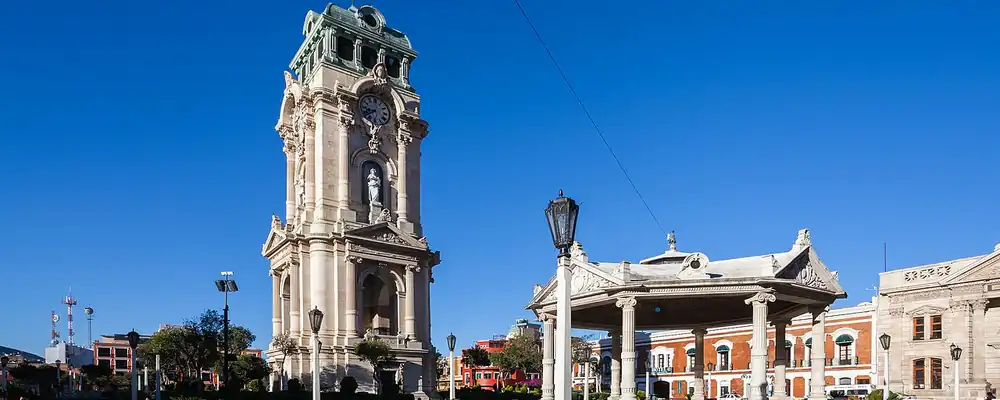
Hidalgo in figures from its history
Toltec Tula, Otomí valleys and the Huasteca hills
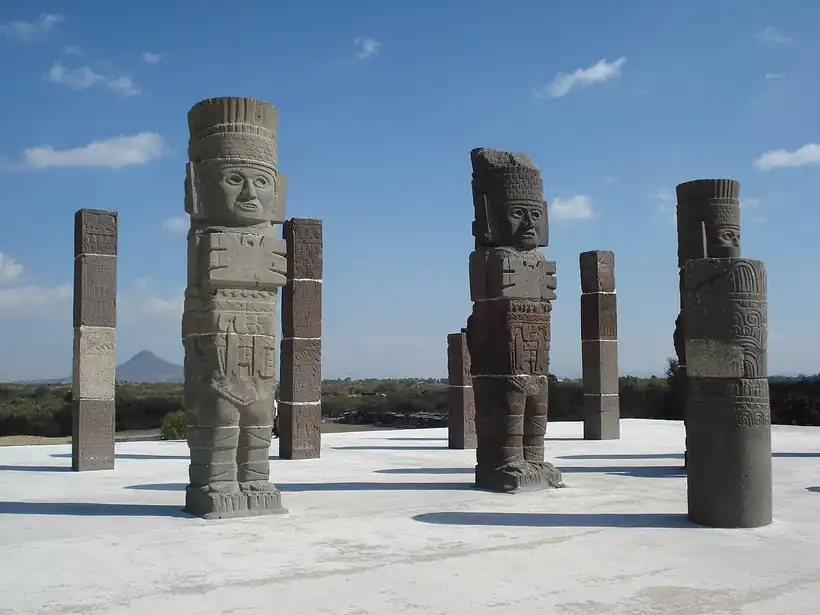
People have lived in what is now Hidalgo for a very long time. A hand axe and spear points from the Cueva del Tecolote at Huapalcalco, near Tulancingo, are dated to about 11,000 BCE. Later settlers worked obsidian, and between 200 and 600 CE the trading town of Xihuingo tied the region to the wider Mesoamerican world. Around 700 CE a city rose on a ridge above the Tula River. Tollan, today's Tula, reached its height between 900 and 1150, when Tula Grande held perhaps 60,000 people. The four basalt warriors on top of Pyramid B, about 4 m tall, still stand there.
Indigenous languages spoken today
Speakers aged 3 and over, census of 2020 6
In the 2020 census 362,629 people aged 3 and over spoke an Indigenous language, 12.3% of that age group. The counts by language are INEGI figures as reported by El Universal Hidalgo (21 Feb 2024); together these four languages account for 357,335 speakers.

Tula fell around 1150, and Otomí and Nahua communities spread across the valleys. The Otomí made the dry Valle del Mezquital their home, while the Huasteca culture flourished in the north-east from about 100 BCE to 1400 CE. In the 15th century the Mexica rulers Moctezuma I and Ahuízotl brought the Huasteca under tribute. Those two peoples still shape the state's language map. In the 2020 census 362,629 people aged 3 and over spoke an Indigenous language, 12.3% of that age group. Most spoke Náhuatl or Otomí, and smaller Tepehua and Totonac communities live in the eastern sierra.
Silver from Pachuca and Real del Monte
The first Franciscans arrived in 1523, and Spanish forces took Pachuca in 1528. Under the rule of Nuño de Guzmán the Indigenous population fell sharply. The Augustinians came next. The parish of Actopan dates from 1546, and its monastery, built about 1550-60 and finished by the 1570s, has an open chapel covered in fresco murals. In 1576 its prior printed the first catechism in Otomí, so that friars could preach in the people's own language. In the Sierra Gorda and the Sierra Baja many Otomí communities kept much of their autonomy.
Interactive maptap or click a state to open its page
Silver changed everything. The veins of Pachuca and Real del Monte were found in 1552, and in 1554 Bartolomé de Medina first used the patio process at scale at Pachuca, mixing crushed ore with mercury in open yards. The method spread across Spanish America and let miners profit from poorer ore. From 1741 Pedro Romero de Terreros drained the flooded workings, and from 1762 he built the refining hacienda of Santa María Regla. When he tried to cut wages and end the partido, the share of ore the miners kept, the workers of Real del Monte struck in 1766. Many consider it the first true labour strike in North America. Mining and farming haciendas, the large estates that refined ore or worked the land with resident labourers, dominated the economy until Independence.
From Cornish engines to a state of its own, 1810-1920
Many in the region, above all Indigenous villagers, backed Miguel Hidalgo in 1810, though no major battles were fought here. At Huichapan on 16 Sep 1812, Ignacio López Rayón and local insurgents held the first public commemoration of the Grito de Dolores. The war left the mines in ruins. In 1824 a British company took over Real del Monte, bringing steam engines and about 350 Cornish miners, and it gave up in 1849 after heavy losses. The region was still part of the State of Mexico, governed from distant Toluca, which fed the wish for a state of its own. During the French Intervention it became a military district, and on 16 Jan 1869 Congress created the State of Hidalgo, with Pachuca as its capital.
1810 to 1920 in Hidalgo
From the timeline below, coloured by era
- 1812On 16 Sep the insurgents at Huichapan hold the first commemoration of the Grito de Dolores. 14
- 1824A British company takes over Real del Monte with steam engines and Cornish miners. 10
- 1869On 16 Jan Congress decrees the creation of the State of Hidalgo, with Pachuca as capital. 3
- 1900Cornish miners play the first football match in Mexico at Pachuca. 10
- 1920The first airmail flight carries 543 letters from Pachuca to Mexico City in 53 minutes. 1
During the Porfiriato, Porfirio Díaz's rule of 1876-1911, the telegraph, the telephone and the railway arrived in the late 1880s, and foreign money returned to the mines. By the early 20th century a USA-based smelting company controlled much of Pachuca and Real del Monte. Pulque haciendas, estates that grew maguey for the fermented drink sold in Mexico City, prospered, while rural villages stayed poor. The Cornish left their mark. Their miners played the first football match in Mexico at Pachuca in 1900, and pastes are still baked in Real del Monte. The Revolution reached the state in 1911, when Nicolás Flores took Jacala and Gabriel Hernández took Tulancingo and Pachuca. After years of rival provisional governors, Flores restored constitutional order in 1917, and a new state constitution followed in 1920.
After silver: trucks, cement and a refinery
Mining declined in the mid-20th century, and Pachuca's economy weakened with it. In 1965 the USA-based company sold its interests to the Mexican government, and the last mine at Real del Monte, San José La Rica, closed in 2005. The state looked for other work. In the 1930s the Cruz Azul cement works was expropriated and more than 130 rural schools were built. In the 1950s the federal government built an industrial town at Ciudad Sahagún, in the south-east. Diesel Nacional (DINA) was created there on 28 Jul 1951 to build trucks and buses, Concarril began its first railway car in 1952, and a textile machinery plant formed in 1954 later became the steelmaker Sidena.
The region, c. 1600 and today
What each state turned on, by the era table below; Hidalgo outlined in gold.
Interactive maptap or click a state to open its page
c. 1600
Hidalgo: Silver mining districts
- Silver mining districts
- Towns, farms and workshops of the old heartland
- Ports, sugar and cacao
Today
Hidalgo: Export manufacturing
- Export manufacturing
- Oil and gas
- Services and government
Its places in the modern era
Numbered as on the map above
- 7Ciudad Sahagún · 1951-2002
Federal industrial town of trucks, railway cars and steel. 15
On 18 Mar 1976 Pemex inaugurated the Miguel Hidalgo refinery at Atitalaquia, near Tula, which with its cement plants became the state's other industrial pole. The old Instituto Científico Literario became the state university in 1961. The model of the 1950s did not last. The Renault plant at Ciudad Sahagún closed in 1986 with about 7,000 jobs lost, Sidena went bankrupt by 1993, and DINA closed its last truck factory in 2002. By 2000 Hidalgo had 2,235,591 people, and its southern edge was being drawn into Greater Mexico City, which formally took in Tizayuca in 2005.
The Arco Norte toll road, whose first phase opened in Jul 2009, crosses the south of the state on its way around Greater Mexico City, and on 21 Mar 2022 the Felipe Ángeles airport opened at Zumpango, in the State of Mexico, 35 km north of Mexico City. The old silver country found a new use. On 5 May 2017 UNESCO recognised the Comarca Minera Geopark, spread over 9 municipalities from Pachuca and Mineral del Monte to Huasca, for its geology and its mining heritage, from colonial refining haciendas to Cornish engine houses and the basalt columns of Santa María Regla. The silver that made Pachuca now draws visitors rather than miners.
Hidalgo, date by date
Before the Spanish before 1519
- c. 11,000 BCE
Hunters leave a hand axe and spear points in the Cueva del Tecolote at Huapalcalco, near Tulancingo. 3
- c. 700
Tula is founded on a ridge above the Tula River. 7
- 900-1150
Tula reaches its height as the Toltec capital, with perhaps 60,000 people. 7
- c. 1150
Tula falls and Otomí and Nahua groups spread across the valleys. 7
The colonial centuries 1519 to 1809
- 1523
The first Franciscan friars arrive in the region. 1
- 1528
Francisco Téllez and about 25 Spaniards take Pachuca. 3
- 1546
The parish of Actopan is founded; its Augustinian monastery rises about 1550-60. 11
- 1552
Silver is found at Pachuca and Real del Monte. 3
- 1554
Bartolomé de Medina first uses the patio process at scale at Pachuca. 9
- 1766
Miners at Real del Monte strike against wage cuts and the loss of the partido. 10
Independence and the Reform 1810 to 1875
The Porfiriato 1876 to 1910
- 1900
Cornish miners play the first football match in Mexico at Pachuca. 10
The Revolution 1910 to 1920
- 1920
The first airmail flight carries 543 letters from Pachuca to Mexico City in 53 minutes. 1
Modern Mexico after 1920
- 1951
Diesel Nacional (DINA) is created, the start of the industrial town of Ciudad Sahagún. 15
- 1965
The USA-based mining company sells its Pachuca interests to the Mexican government. 8
- 1976
On 18 Mar Pemex inaugurates the Miguel Hidalgo refinery near Tula. 16
- 2017
UNESCO recognises the Comarca Minera Geopark on 5 May 2017. 20
Where Hidalgo stood: c. 1600, 1910 and today
Interactive maptap or click a state to open its page
c. 1600
Silver, the heartland and the frontier
Hidalgo: Silver mining districts
- Silver mining districts
- Towns, farms and workshops of the old heartland
- Ports, sugar and cacao
- Indigenous south: cochineal, maize, tribute
- Maya lands under encomienda or beyond Spanish rule
- Frontier: missions, presidios, independent peoples
1910
The Porfiriato at its height
Hidalgo: Mining
- Mining
- Oil
- Henequén
- Sugar and textile mills
- Haciendas: grain, pulque, cattle
- Export crops: coffee, tobacco, cacao, chicle, timber
- Steel, cotton and the railway north
- Ranching frontier
- The national capital
Today
What each state turns on now
Hidalgo: Export manufacturing
- Export manufacturing
- Oil and gas
- Tourism
- Farming and agro-exports
- Mining
- Ports and logistics
- Services and government
Why Mexico's own reading of what each state's economy turned on in that period, drawn from the sources listed in each state's room; a classification, not a measurement.
Today's numbers for Hidalgo
Output, exports, jobs, wages and investment now, each with its source and date.
The bookBook 6, Where to Go in Mexico, chapter 16
Where to Go in Mexico: The Center, the corridor this state belongs to.
Why MexicoThe national timeline
The turning points of the whole country, each dated, each with its source.
Sources, each with its date
- Wikipedia (English), Hidalgo (state), History section, 3 Nov 2026 · read 3 Nov 2026 · link
- Wikipedia (Spanish), Hidalgo (estado), 3 Nov 2026 · read 3 Nov 2026 · link
- Wikipedia (Spanish), Historia de Hidalgo, 3 Nov 2026 · read 3 Nov 2026 · link
- INEGI, Censo de Población y Vivienda 2020, results for Hidalgo (press release 58/21), 26 Jan 2021 · read 3 Nov 2026 · link
- Tercer Censo de Población 1910, table VI, population of the states in 1895, 1900 and 1910 (Universidad Veracruzana transcription), 1910 · read 3 Nov 2026 · link
- El Universal Hidalgo, 'En Hidalgo, 362 mil personas hablan alguna lengua indígena' (INEGI figures by language), 21 Feb 2024 · read 3 Nov 2026 · link
- Wikipedia (English), Tula (Mesoamerican site), 3 Nov 2026 · read 3 Nov 2026 · link
- Wikipedia (English), Pachuca, 3 Nov 2026 · read 3 Nov 2026 · link
- Wikipedia (English), Patio process, 3 Nov 2026 · read 3 Nov 2026 · link
- Wikipedia (English), Mineral del Monte, 3 Nov 2026 · read 3 Nov 2026 · link
- Wikipedia (English), Actopan, Hidalgo, 3 Nov 2026 · read 3 Nov 2026 · link
- Wikipedia (English), Huasca de Ocampo, 3 Nov 2026 · read 3 Nov 2026 · link
- Wikipedia (English), Huichapan, 3 Nov 2026 · read 3 Nov 2026 · link
- México Desconocido, 'El Chapitel: el sitio de la primera conmemoración del Grito de Dolores', 7 Sep 2026 · read 3 Nov 2026 · link
- Wikipedia (English), Ciudad Sahagún, 3 Nov 2026 · read 3 Nov 2026 · link
- Wikipedia (Spanish), Refinería Miguel Hidalgo, 3 Nov 2026 · read 3 Nov 2026 · link
- El CEO, 'Breve historia del Sistema Nacional de Refinación', 12 Jun 2019 · read 3 Nov 2026 · link
- Wikipedia (English), Arco Norte, 3 Nov 2026 · read 3 Nov 2026 · link
- Wikipedia (English), Felipe Ángeles International Airport, 3 Nov 2026 · read 3 Nov 2026 · link
- Wikipedia (English), Comarca Minera Geopark, 3 Nov 2026 · read 3 Nov 2026 · link
Pictures
- Reloj Monumental, Pachuca, Hidalgo, México, 2013-10-10, DD 05: Diego Delso, CC BY-SA 3.0, Wikimedia Commons · read 3 Nov 2026
- Atlantes de Tula Hidalgo: Rafael Aparicio, CC BY-SA 3.0, Wikimedia Commons · read 3 Nov 2026

Where the sources disagree
- Real del Monte strike: Wikipedia (English, Mineral del Monte) dates it 1766; Wikipedia (Spanish, Historia de Hidalgo) dates the first miners' protest against Romero de Terreros to 1776. This page uses 1766.
- First commemoration of the Grito at Huichapan: México Desconocido gives 16 Sep 1812; Wikipedia (Spanish, Historia de Hidalgo) gives 13 Sep 1812. This page uses 16 Sep 1812.
Guerrero
Olmec-age painted caves, Taxco silver and Acapulco's galleons to Asia, then the land of Morelos, Guerrero and Álvarez, and in the 20th century the resort coast.
All 32 on the mapNext →Jalisco
From the round temples of the Teuchitlán valleys to the factories of Guadalajara, Jalisco grew from the frontier of Nueva Galicia into the heart of western Mexico.