Michoacán
From the Purépecha kingdom that held off the Aztecs to the birthplace of Morelos and the dams of the Balsas, Michoacán has shaped Mexico on its own terms.
Capital: Morelia · Became a state: 1823 · Checked 3 Nov 2026
Interactive maptap or click a state to open its page
Michoacán in figures from its history
Lake Pátzcuaro and the Purépecha kingdom
People hunted mammoth and bison in Michoacán long before farming began. At El Opeño, between about 1500 and 800 BCE, villagers buried their dead in shaft tombs with pottery and figurines. Later centres at Tingambato and Tres Cerritos traded with Teotihuacan, and by about 800 CE the obsidian mines of Zináparo were sending stone to central Mexico. Metalworking arrived with traders who travelled the Lerma and Balsas rivers, and the Purépecha later worked copper, silver and gold.
Indigenous languages spoken today
Speakers aged 3 and over, census of 2020 3
People aged 3 and over, 2020 census. In all, 154,943 people in Michoacán speak an Indigenous language, 3.4% of that age group; 8,878 of them do not speak Spanish. Counts by language are the INEGI figures as given in Wikipedia (Spanish).
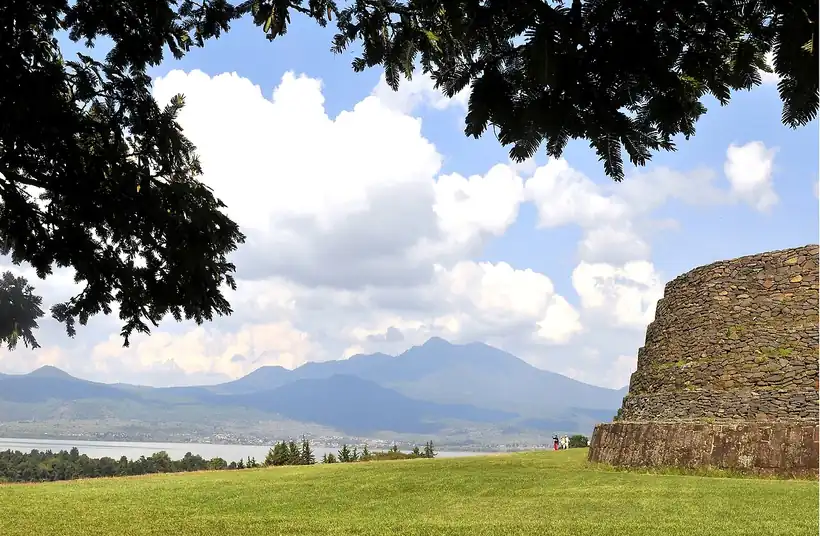

From about 1300 the ruler Tariácuri united the towns around Lake Pátzcuaro. His heirs built a state that by the mid-15th century was governed from Tzintzuntzan, a city of 25,000 to 30,000 people with its row of five round-backed temple platforms, the yácatas. Purépecha armies beat back Aztec invasions in the 1470s and after 1480, and the kingdom covered most of today's Michoacán and parts of 3 neighbouring states. Purépecha is still the first Indigenous language of the state, with 128,620 speakers in 2020, alongside Nahuatl, Mazahua and Otomí.
Tata Vasco, the bishopric and the mines of the east
A Spanish force under Cristóbal de Olid reached Tzintzuntzan in 1522 and the Purépecha army did not fight. The ruler, Tangáxuan II, submitted on the promise that he would keep his throne. Nuño de Guzmán broke that promise and had him executed on 14 Feb 1530. The bishop Vasco de Quiroga, still remembered as Tata Vasco ('Father Vasco'), then set the tone of the colony. He made Pátzcuaro his seat in 1538, founded the Colegio de San Nicolás in 1540 and built hospitals, among them the Huatápera in Uruapan.
Interactive maptap or click a state to open its page
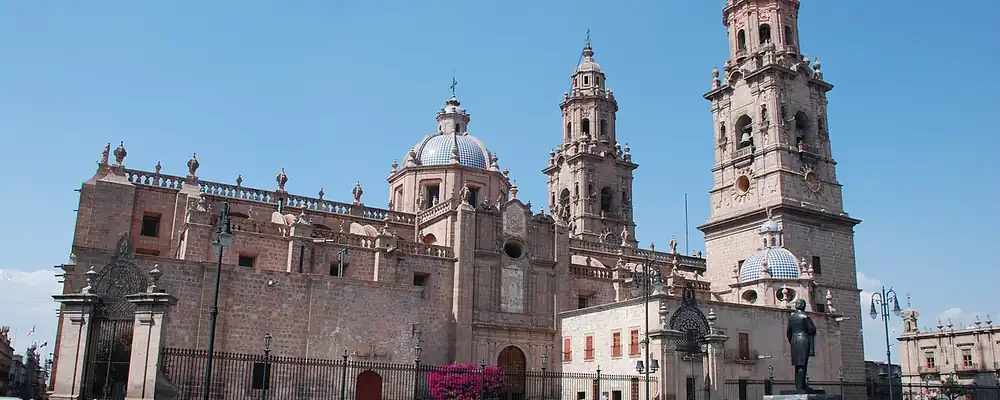
Viceroy Antonio de Mendoza founded the city now called Morelia in 1541, and after Quiroga's death in 1565 it became the political and church capital. Michoacán became a province of its own in 1602 and its cathedral was finished in 1744. The wealth came from mines at Tlalpujahua, worked from 1558, and Angangueo, from cattle ranches and from haciendas, large landed estates, held mostly by Spanish-born owners. Indigenous people did the work, often by force, and slavery was not uncommon. War, epidemics and the earthquakes of 1567 and 1575 cut the Indigenous population, which by the mid-17th century had fallen by half.
Places in its history
Morelia
City · 1541
State capital, founded in 1541 and named for Morelos in 1828; World Heritage since 1991. 6
Tzintzuntzan
Archaeological site · c. 1450-1530
Capital of the Purépecha state, with its five yácatas facing Lake Pátzcuaro. 7
Paricutín volcano
Archaeological site · 1943-52
The volcano that rose from a cornfield and buried 2 villages. 10
Morelos, Apatzingán and the Cárdenas land reform
Michoacán was a seedbed of Independence. A plot in the capital was broken up in Dec 1809, and Miguel Hidalgo, who had been educated in Michoacán, returned in 1810 and decreed the end of slavery. José María Morelos was born in the city, and on 22 Oct 1814 the insurgent congress swore the Constitution of Apatzingán, the first constitution of the independence movement. Agustín de Iturbide, also from Michoacán, took the capital on 22 May 1821. The state was created in Dec 1823, and in 1828 the capital was renamed Morelia in honour of Morelos. In the Reform years, when liberal laws sold off Church and communal lands, Melchor Ocampo spoke for the liberals; troops of the French Intervention took Morelia in 1863 and burned much of Zitácuaro.
1810 to 1920 in Michoacán
From the timeline below, coloured by era
- 1814The insurgent congress swears the Constitution of Apatzingán on 22 Oct. 4
- 1823Michoacán is erected as a state of the federation on 22 Dec. 3
- 1828The capital is renamed Morelia in honour of José María Morelos, who was born there. 6
- 1883The railway reaches Morelia. 4
- 1898A gold strike at Tlalpujahua opens the Dos Estrellas mine. 11
Under Porfirio Díaz, who ruled from 1876 to 1911 (the Porfiriato), the railway reached Morelia in 1883, Pátzcuaro in 1886 and Uruapan around 1899. Sugar grew at Taretan, coffee at Uruapan, and the Italian settler Dante Cusi irrigated the hot lowlands at Lombardía and Nueva Italia for rice. In 1898 a large gold vein opened the Dos Estrellas mine at Tlalpujahua. The Revolution began here in May 1911 at Santa Clara del Cobre, and Salvador Escalante entered Morelia on 30 May. The Cristero War of 1926-29, a Catholic rising against the federal government's anticlerical laws, closed the seminaries of Morelia and Zamora. As governor from 1928 to 1932, Lázaro Cárdenas made peace and began land reform, handing about 400,000 hectares to some 24,000 peasants.
Volcano, rivers and a port on the Pacific
As president from 1934 to 1940, Cárdenas kept redistributing land, built irrigation dams and saw the Mexico City to Guadalajara highway cross northern Michoacán. On 20 Feb 1943 a new volcano, Paricutín, rose from a cornfield and kept erupting until 1952, burying the villages of Paricutín and San Juan Parangaricutiro. At Tlalpujahua a flood of mud and mine waste on 27 May 1937 buried a third of the town; the mine had yielded about 45,000 kg of gold before it closed in 1959.
The region, c. 1600 and today
What each state turned on, by the era table below; Michoacán outlined in gold.
Interactive maptap or click a state to open its page
c. 1600
Michoacán: Towns, farms and workshops of the old heartland
- Silver mining districts
- Towns, farms and workshops of the old heartland
- Ports, sugar and cacao
Today
Michoacán: Farming and agro-exports
- Export manufacturing
- Tourism
- Farming and agro-exports
- Ports and logistics
- Services and government
Its places in the modern era
Numbered as on the map above
- 5Paricutín volcano · 1943-52
The volcano that rose from a cornfield and buried 2 villages. 10
The federal government turned to the Balsas basin. The Tepalcatepec Commission was set up in 1947 to plan irrigation and power for the hot lowlands, and in 1960 it was folded into the Balsas River Commission, which Cárdenas joined as its executive member in 1961. El Infiernillo dam began operating on 15 Jun 1964 with 1,120 MW. A 1962 decree authorised a steel complex at the river mouth, the port channel was dredged from the late 1960s, and in 1970 the town took the name Lázaro Cárdenas. In 1997 Michoacán avocados regained entry to the USA market, the start of a large export trade.
The port at the mouth of the Balsas gave Michoacán a new role in 2003, when a container terminal reopened there under a new concession, with Hong Kong's Hutchison Ports as majority partner, placed to feed a rail corridor running north towards the USA Midwest. Inland, the avocado trade with the USA, reopened in 1997, kept the uplands tied to the same northern market. Both rest on 20th-century choices, from Cárdenas's land reform to the dams of the Balsas Commission and the steel town decreed at the river mouth in 1962.
Michoacán, date by date
Before the Spanish before 1519
- c. 1500 BCE
Villagers at El Opeño begin burying their dead in shaft tombs. 2
- c. 800
Output rises at the Zináparo obsidian mines as trade with central Mexico grows. 2
- c. 1300
Tariácuri begins uniting the towns of the Lake Pátzcuaro basin. 8
- c. 1450
Tzintzuntzan becomes the seat of the Purépecha state. 7
- 1470s
Purépecha armies defeat an Aztec invasion led by Axayácatl. 8
The colonial centuries 1519 to 1809
Independence and the Reform 1810 to 1875
The Porfiriato 1876 to 1910
Modern Mexico after 1920
- 1928-32
Governor Lázaro Cárdenas ends the Cristero fighting and begins land reform. 4
- 1943
The Paricutín volcano is born in a cornfield on 20 Feb. 9
- 1964
El Infiernillo dam on the Balsas begins producing power. 15
- 1970
The new port and steel town at the mouth of the Balsas takes the name Lázaro Cárdenas. 14
- 2003
A container terminal reopens at Lázaro Cárdenas under a new concession, with Hutchison Ports as majority partner. 18
Where Michoacán stood: c. 1600, 1910 and today
Interactive maptap or click a state to open its page
c. 1600
Silver, the heartland and the frontier
Michoacán: Towns, farms and workshops of the old heartland
- Silver mining districts
- Towns, farms and workshops of the old heartland
- Ports, sugar and cacao
- Indigenous south: cochineal, maize, tribute
- Maya lands under encomienda or beyond Spanish rule
- Frontier: missions, presidios, independent peoples
1910
The Porfiriato at its height
Michoacán: Haciendas: grain, pulque, cattle
- Mining
- Oil
- Henequén
- Sugar and textile mills
- Haciendas: grain, pulque, cattle
- Export crops: coffee, tobacco, cacao, chicle, timber
- Steel, cotton and the railway north
- Ranching frontier
- The national capital
Today
What each state turns on now
Michoacán: Farming and agro-exports
- Export manufacturing
- Oil and gas
- Tourism
- Farming and agro-exports
- Mining
- Ports and logistics
- Services and government
Why Mexico's own reading of what each state's economy turned on in that period, drawn from the sources listed in each state's room; a classification, not a measurement.
Today's numbers for Michoacán
Output, exports, jobs, wages and investment now, each with its source and date.
The bookBook 6, Where to Go in Mexico, chapter 17
Where to Go in Mexico: The West, the corridor this state belongs to.
Why MexicoThe national timeline
The turning points of the whole country, each dated, each with its source.
Sources, each with its date
- Tercer Censo de Población de los Estados Unidos Mexicanos, 1910, Table VI, population of the federal entities in 1895, 1900 and 1910 (Universidad Veracruzana digital edition), 1910 · read 3 Nov 2026 · link
- Wikipedia (English), Michoacán, History section, 3 Nov 2026 · read 3 Nov 2026 · link
- Wikipedia (Spanish), Michoacán, 3 Nov 2026 · read 3 Nov 2026 · link
- Wikipedia (Spanish), Historia de Michoacán, 3 Nov 2026 · read 3 Nov 2026 · link
- INEGI, Censo de Población y Vivienda 2020, results for Michoacán, press release 48/21, 26 Jan 2021 · read 3 Nov 2026 · link
- Wikipedia (English), Morelia, 3 Nov 2026 · read 3 Nov 2026 · link
- Wikipedia (English), Tzintzuntzan (Mesoamerican site), 3 Nov 2026 · read 3 Nov 2026 · link
- Wikipedia (English), Tarascan state, 3 Nov 2026 · read 3 Nov 2026 · link
- Wikipedia (English), Parícutin, 3 Nov 2026 · read 3 Nov 2026 · link
- Wikipedia (Spanish), Paricutín, 3 Nov 2026 · read 3 Nov 2026 · link
- Wikipedia (English), Tlalpujahua, 3 Nov 2026 · read 3 Nov 2026 · link
- Wikipedia (English), Apatzingán, 3 Nov 2026 · read 3 Nov 2026 · link
- Wikipedia (English), Lázaro Cárdenas, Michoacán, 3 Nov 2026 · read 3 Nov 2026 · link
- Wikipedia (Spanish), Lázaro Cárdenas (Michoacán), 3 Nov 2026 · read 3 Nov 2026 · link
- Wikipedia (Spanish), Presa El Infiernillo, 3 Nov 2026 · read 3 Nov 2026 · link
- Wikipedia (English), Balsas River, 3 Nov 2026 · read 3 Nov 2026 · link
- Encyclopaedia Britannica, Commission of the Balsas River Valley, 3 Nov 2026 · read 3 Nov 2026 · link
- Hutchison Port Holdings, news release 'HPH acquires container terminal in the port of Lazaro Cardenas, Mexico', 21 Jul 2003, 21 Jul 2003 · read 3 Nov 2026 · link
- Wikipedia (English), Port of Lázaro Cárdenas, 3 Nov 2026 · read 3 Nov 2026 · link
Pictures
- Morelia Cathedral DSC 0524 AD: Adavyd, CC BY-SA 3.0, Wikimedia Commons · read 3 Nov 2026
- Tzintzuntzan 09: LBM1948, CC BY-SA 4.0, Wikimedia Commons · read 3 Nov 2026

Where the sources disagree
- Renaming of the capital as Morelia: Wikipedia (English, Morelia) gives 1828; Wikipedia (Spanish, Historia de Michoacán) ties it to the 1825 Ley Territorial. This page uses 1828.
- Universidad Michoacana: Wikipedia (Spanish, Historia) places its formation in 1917; Wikipedia (English) gives 1920. This page leaves the date out.
- Busiest port: Wikipedia (English, Lázaro Cárdenas) calls it Mexico's busiest cargo port; Wikipedia (English, Manzanillo) says Manzanillo is. This page makes no ranking claim.
State of Mexico
Teotihuacan, the Matlatzinca and Mazahua valleys, early silver and pulque, a great state cut down to size, then the factory belt and new cities around the capital.
All 32 on the mapNext →Morelos
From Chalcatzingo and Xochicalco to Cortés's sugar estates, the siege of Cuautla and Zapata's fight for land, the valleys of Morelos turned on who held the soil.