Nearly three thousand years of cities before Spain, and many thousands of years of people before the cities. This room gathers what our 32 state histories hold for the era, 117 dated events and 62 places, and sets them in the national story.
Interactive maptap or click a state to open its page
1 to 2 dated events
3 to 4 dated events
5 to 6 dated events
7 or more dated events
Archaeological site
Battlefield
City
Hacienda
Port
Click a state to open its history; hover a dot for its name and date.Tap a state to open its history.
Disputedc. 26,000 years ago (claimed)Stone pieces in Chiquihuite Cave, Zacatecas, are dated to about 26,000 years ago by their excavators; critics argue they may be natural stones, and no hearth or human remains have been found. Disputed. 2
15,000 to 20,000 years agoThe span in which most scholars place the first people south of the North American ice sheets; the sites broadly accepted all fit an age of about 15,000 years. 1
c. 13,390 years agoClovis hunters camp at El Fin del Mundo, Sonora, believed the oldest Clovis site in North America: the oldest firmly dated human presence in our state histories. 3
c. 9,000 years agoMaize is domesticated from teosinte, most likely in the Balsas River valley of south-central Mexico. 6
c. 6,250 years agoThe oldest known maize ears are left in Guilá Naquitz cave, in the Valley of Oaxaca. 6
c. 1200 to 400 BCEThe Olmec of the Gulf coast: San Lorenzo, then La Venta from about 900 BCE; seventeen colossal heads are known. 7
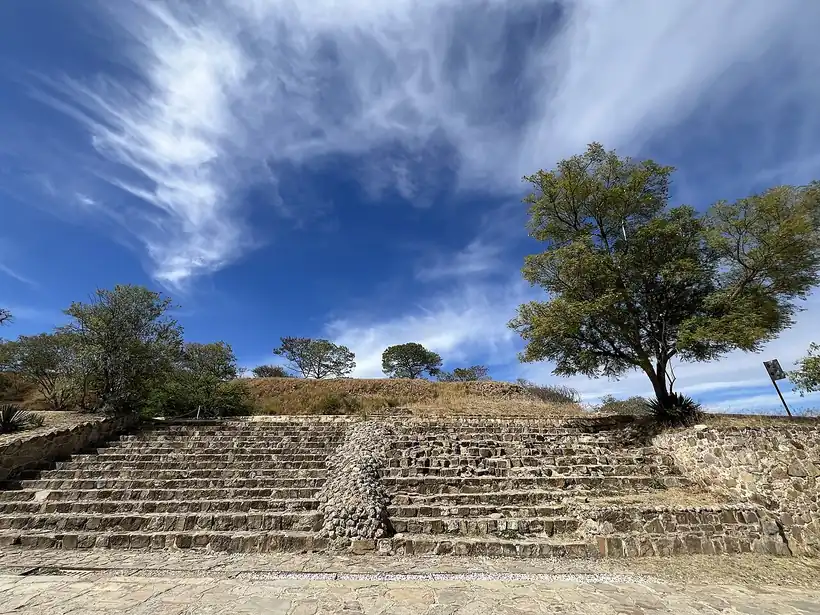
c. 500 BCEMonte Albán is founded above the Valley of Oaxaca; it is the leading Zapotec centre for nearly a thousand years. 8
1st century to c. 600 CETeotihuacan grows from about the first century and at its height holds some 80% of the people of the Basin of Mexico; it falls around 600 and is abandoned by about 700. 9
250 to 900The Classic Maya: the great southern lowland cities, then their abandonment in the ninth century; in the north, Chichén Itzá and Uxmal flourished. 9
900 to 1200Tula, in today's Hidalgo, is the leading Toltec centre of the Early Postclassic; how far its power reached is argued. 9
1000s to 1100sMixtec rulers bring much of the Mixteca under one rule for a time; later Mixtec lords are buried in a reused tomb at Monte Albán. 98
c. 1300The Purépecha state takes shape under Tariácuri, ruling from Pátzcuaro (Tzintzuntzan, on the same lake, later became the capital); in the 1470s it turns back the Mexica army. 12
1325The Mexica found Tenochtitlan on Lake Texcoco (the exact date is unclear; 13 March 1325 was chosen in 1925). 10
1428Tenochtitlan, Texcoco and Tlacopan form the Triple Alliance, the Aztec Empire (another reading gives 1430). 109
8 Nov 1519Hernán Cortés, landed near Veracruz in April and allied with Tlaxcala on the march, enters Tenochtitlan, then one of the largest cities in the world (estimates run from 60,000 to 400,000). 1110
The story
What happened, and what is still argued
When did the great cultures flourish?Approximate spans, 1500 BCE to 1521, as the sources give them
The first people: what is accepted and what is not
People reached the Americas from Asia, and most scholars place their arrival south of the ice sheets somewhere between 15,000 and 20,000 years ago. In Mexico the firmest early date in our state histories is El Fin del Mundo, in Sonora, where Clovis hunters camped about 13,390 years ago.
Older dates exist and are argued over: Chiquihuite Cave in Zacatecas, and the White Sands footprints in New Mexico. Two of our state pages carried early dates on thin ground, Guerrero and Jalisco; both are now marked. The detail is below, under where the sources disagree.
The plant that made Mexico was bred here. Maize came from a wild grass, teosinte, about 9,000 years ago, most likely in the Balsas valley; the oldest known ears, from Guilá Naquitz in Oaxaca, are about 6,250 years old. With maize, beans and squash came settled farming, then villages, then the first towns of the Preclassic (Formative) period.
The Olmec of the Gulf coast built San Lorenzo and La Venta between about 1200 and 400 BCE and left the colossal heads; Alfonso Caso called them "the mother culture" in 1942, a view later finds have weakened. Monte Albán, founded about 500 BCE, held the Zapotec centre of Oaxaca for nearly a thousand years. Teotihuacan, growing from about the first century, became the great city of the central highlands until its fall around 600. In the south and east the Classic Maya cities flourished from 250 to 900; the southern lowland cities were then abandoned, while Chichén Itzá and Uxmal flourished in the north.
After the Classic came the Postclassic, from 900 to 1521. Tula was the leading Toltec centre; Mixtec lords brought much of the Mixteca under one rule in the eleventh and twelfth centuries; the Purépecha, from Lake Pátzcuaro, held the west and turned back the Mexica in the 1470s. The Mexica founded Tenochtitlan on an island of Lake Texcoco in 1325 and, allied with Texcoco and Tlacopan from 1428, built the empire Cortés found in 1519: a capital that estimates put at 60,000 to 400,000 people, most estimates above 200,000, on most estimates larger than any city in Spain. Trade tied the whole region together long before: turquoise from the north, obsidian from the highlands, cacao and feathers from the south.
All 117 dated events of the era in our 32 state histories
Where and when did it happen?One dot per dated event, one row per state, coloured by corridor; hover a dot to read it
Slide the chart to see all of it →
The Texas-Facing NorthThe Pacific BorderThe Bajío and Center-NorthThe CenterThe WestThe Gulf and the IsthmusThe PeninsulaThe Deep South: Guerrero, Oaxaca and Chiapas
The full list, oldest first. Each state name opens its history, where the event carries its source.
See all 117 events
c. 20,000 years ago (unproven)GuerreroHunter-gatherers leave early traces in Guerrero's caves; a 2005 state encyclopedia dates the first to about 20,000 years ago, older than any site broadly accepted in the Americas.
c. 15,000 years ago (unconfirmed)JaliscoPeople are living by the lakes of Chapala and Zacoalco.
c. 13,390 years agoSonoraClovis hunters camp at El Fin del Mundo, believed the oldest Clovis site in North America.
c. 11,000 BCEHidalgoHunters leave a hand axe and spear points in the Cueva del Tecolote at Huapalcalco, near Tulancingo.
12,000+ years agoCoahuilaThe first people settle near the Nazas and Aguanaval rivers, in what is now La Laguna.
c. 9000 BCEBaja CaliforniaThe first people reach the peninsula at least 11,000 years ago.
c. 8000 BCEBaja California SurPeople are living at the cape at least 10,000 years ago.
c. 7900 BCEQuintana RooA woman is buried in the Chan Hol cave near Tulum, at least 9,900 years ago.
c. 7000 BCEChiapasHunter-gatherers occupy the central valley of Chiapas.
c. 7000-5500 BCESinaloaA pre-ceramic people camps at Las Labradas, on the coast of San Ignacio.
c. 6960 BCENuevo LeónOldest dated hearth at Boca de Potrerillos, a site used for some 8,000 years.
c. 6000 BCEMorelosHunters and gatherers live near Yautepec and Chimalacatlán.
c. 6000 BCETamaulipasPeople have lived in the region for at least 8,000 years; the Diablo complex in the Sierra de Tamaulipas holds early traces.
c. 5500 BCEBaja California SurThe earliest radiocarbon dates for the Great Murals of the Sierra de San Francisco.
c. 5000 BCENayaritPeople may already be settling in what is now Nayarit.
c. 3600 BCEPueblaDate of the oldest maize found in the caves of the Tehuacán Valley.
c. 2500 BCEState of MexicoPottery appears at Tlapacoya, Tlatilco and other sites.
c. 2000 BCEChihuahuaFarmers in the north begin growing maize and, soon after, squash.
c. 2000 BCEColimaThe Capacha culture develops, among the earliest pottery makers of West Mexico.
c. 2000 BCEOaxacaFarming villages are settled in the Central Valleys.
c. 1500 BCEChiapasThe Mokaya of the Soconusco grow maize and live in houses.
c. 1500 BCEMichoacánVillagers at El Opeño begin burying their dead in shaft tombs.
c. 1200-900 BCEGuerreroOlmec-style paintings are made in the Juxtlahuaca cave.
c. 1200 BCEMexico CityFarming villages take root at Cuicuilco on the southern shore of the lake.
c. 1200-900 BCEVeracruzSan Lorenzo is the largest city in Mesoamerica and the heart of the Olmec world.
c. 1000 BCEBaja CaliforniaKumeyaay painters decorate the rocks of El Vallecito, near La Rumorosa.
c. 1000-500 BCEGuerreroTeopantecuanitlán is inhabited near the Amacuzac and Mezcala rivers.
c. 1000-800 BCETabascoAguada Fénix, the largest and oldest known Maya monument, is built near the San Pedro River.
c. 900-400 BCETabascoLa Venta is the leading Olmec city, with its great earthen pyramid and colossal heads.
c. 850-100 BCEChiapasIzapa reaches its height and raises its carved stelae.
c. 800 BCEGuanajuatoThe Chupícuaro culture takes shape in the Bajío.
The first arrival: most scholars place it 15,000 to 20,000 years ago; Chiquihuite Cave (about 26,000, Ardelean et al. 2020) and White Sands (21,000 to 23,000) are argued over. 12
Guerrero's earliest traces: Wikipedia (English) gives about 20,000 years ago, citing a 2005 state encyclopedia; older than any site broadly accepted in the Americas, so marked unproven. 4
Jalisco's lakeside people: Wikipedia (Spanish) gives about 15,000 years ago without a citation; marked unconfirmed. 5
Tenochtitlan in 1519: from 60,000 to over 300,000 (conquest article) or 200,000 to 400,000 (Tenochtitlan article). 1110
The Triple Alliance: 1428 (Tenochtitlan article) or 1430 (Mesoamerican chronology). 109
Monte Albán's end: it lost its pre-eminence by about 750 and was largely abandoned by 900 to 1000; the chronology gives about 850. 89