Thirty-four years of Díaz's order, with the González interlude: railways and foreign money, mines and the first oil wells, haciendas that grew as villages lost their land, and the wars on the Yaqui and the Maya, until the strikes of 1906 and 1907 and the call to revolt in 1910. This room gathers what our 32 state histories hold for the era, 42 dated events and 17 places.
Interactive maptap or click a state to open its page
0 dated events
1 dated event
2 dated events
3 or more dated events
City
Port
Mine
Railway
Battlefield
Click a state to open its history; hover a dot for its name and date.Tap a state to open its history.
29 Nov 1876Díaz, risen in arms under the Plan of Tuxtepec, enters Mexico City; he takes formal control of the presidency at the start of 1877. 42
1880 to 1884Manuel González is president. Díaz returns on 1 December 1884 and rules until 1911. 42
Mar 1884The Mexican Central Railway opens its main line from Mexico City to Paso del Norte (today Ciudad Juárez), on the USA border. 6
23 Apr 1887Cajeme, leader of the Yaqui resistance in Sonora, is executed at Tres Cruces de Chumampaco. 8
1893José Yves Limantour takes over Finance, and the companies selling off public land boom. 3
1897A peace between the Yaquis and the government is signed at Ortiz; it does not last. 8
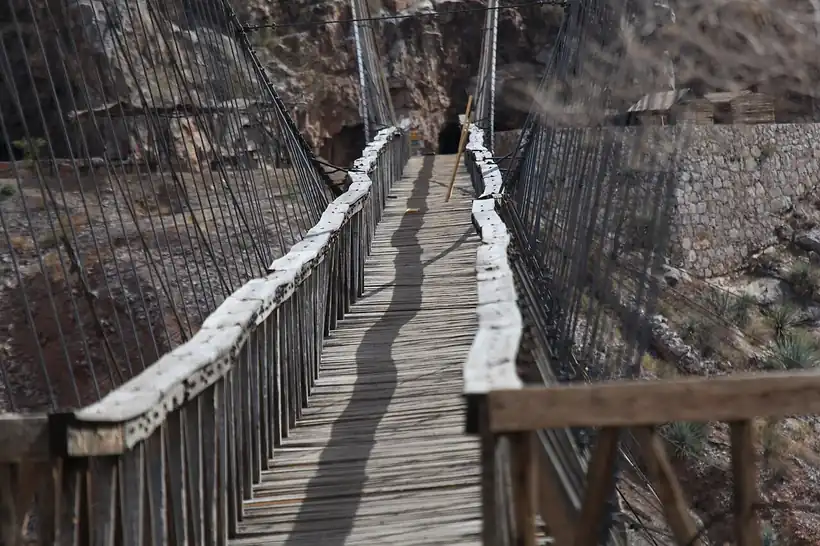
1899The Ojuela suspension bridge, steel from John A. Roebling's Sons of New Jersey, carries the Peñoles mine railway over a canyon at Mapimí, Durango (some sources give 1892). 12
1900At Mazocoba, in the Yaqui sierra, the army kills several hundred people. By then over 90% of the communal land of the central plateau has been sold off or expropriated. 84
c. 1901Edward L. Doheny opens the Ébano oil field beside the Mexican Central Railway; commercial crude production begins. 7
5 May 1901General Ignacio Bravo occupies the Maya rebels' town and telegraphs that the Caste War is over; it is declared over for the last time only in 1915. 1
From 1903The government decides to deport Yaquis to Yucatán and Oaxaca; between 15,000 and 60,000 Yaquis die in the deportations of 1900 to 1911. 8
1 Jun 1906Miners strike at the Cananea Consolidated Copper Company, in Sonora, for five pesos and eight hours; 275 armed volunteers under Captain Thomas Rynning of the Arizona Rangers cross the border against the orders of Arizona's governor, and about 33 workers are killed. 9
7 to 8 Jan 1907At the French-controlled textile mill of Río Blanco, near Orizaba, soldiers put down the strike that followed a Christmas Eve lockout: 50 to 70 dead by conservative counts. 10
Mar 1908In an interview published in Pearson's Magazine, Díaz tells James Creelman he will not serve again and would welcome an opposition party; he then runs once more. 1113
Jul 1908Weetman Pearson strikes oil at San Diego de la Mar; the same year a fire at the Dos Bocas well burns for over a month. 7
Feb 1909Ferrocarriles Nacionales de México, under government control, takes over the Mexican Central. 6
1910Mexico has 24,720 km of track in service, against 640 km when Díaz first took office. 5
20 Nov 1910The date Francisco I. Madero's Plan of San Luis Potosí, published in October, set for the revolt, at 6 p.m.: the next era begins. Díaz resigns and leaves for Paris in May 1911. 134
The story
What happened, and what is still argued
How much railway did the Porfiriato build?Kilometres of track, the two figures our source gives
640 kmwhen Díaz first took office, 1876
→
24,720 kmin service, 1910
nearly 39 timesas much track, in 34 years
Spanish Wikipedia gives a lower count of what was built; see where the sources disagree.
Díaz took power in 1876, risen in arms under the Plan of Tuxtepec, and pursued a policy of “order and progress”. After one term he handed the presidency to Manuel González (1880 to 1884), then took it back and kept it, election after election, until 1911.
Railways transformed the economy. The capital, the track and the rolling stock were foreign. The Mexican Central reached the USA border at Paso del Norte (today Ciudad Juárez) in 1884, and the network grew from 640 km at Díaz's start to 24,720 km in service by 1910. In 1909 a company under government control, Ferrocarriles Nacionales de México, took over the Central.
The world price of silver fell in 1873, and under Díaz industrial minerals became the core of mining, much of it on USA capital. The Ojuela bridge in Durango, built for the Peñoles mine in 1899, is one of its monuments.
Oil began around 1901, when Edward L. Doheny opened the Ébano field; Weetman Pearson struck oil in 1908. Mexico's first oil export left Tampico in 1911, in the next era.
As the estates spread, often in foreign hands, village lands were declared “vacant” even when people lived on them, and the courts set their titles aside. Land-survey companies boomed after 1893. By 1900 over 90% of the communal land of the central plateau had been sold off or expropriated.
In Sonora the Yaqui fought for their river valley. Their leader Cajeme was executed in 1887; a peace signed at Ortiz in 1897 did not hold, and at Mazocoba in 1900 the army killed several hundred. From 1903 the government deported Yaquis to Yucatán and Oaxaca; between 15,000 and 60,000 died in the deportations.
In the southeast, General Ignacio Bravo occupied the Maya rebels' town in May 1901 and declared the Caste War over.
Workers organised. At Cananea in 1906 copper miners struck for five pesos and eight hours, and armed volunteers crossed from Arizona against their governor's orders; about 33 were killed. At Río Blanco in 1907 soldiers put down a textile strike, with 50 to 70 dead.
In 1908 Díaz told an American journalist that he would retire; in 1910 he ran again. Francisco I. Madero set 20 November 1910 for a revolt, and Díaz left for Paris in May 1911.
All 42 dated events of the era in our 32 state histories
Where and when did it happen?7 of the 32 record no dated event in this era. One dot per dated event, one row per state, coloured by corridor; hover a dot to read it
Slide the chart to see all of it →
The Texas-Facing NorthThe Pacific BorderThe Bajío and Center-NorthThe CenterThe WestThe Gulf and the IsthmusThe PeninsulaThe Deep South: Guerrero, Oaxaca and Chiapas
The full list, oldest first. Each state name opens its history, where the event carries its source.
See all 42 events
1876OaxacaPorfirio Díaz takes power through the revolt of Tuxtepec.
1882Baja CaliforniaThe seat of the northern district moves from Real del Castillo to Ensenada on 15 May.
Track in 1910: 24,720 km in service (Rail transport in Mexico); more than 19,000 km built over the 31 years (Spanish Wikipedia, Porfiriato). 53
When Díaz began: he entered Mexico City on 29 November 1876 and held a brief first term, but took formal control only at the start of 1877. 4
The communal land: the figure of over 90% of the central plateau's communal land gone by 1900 is carried by the Porfirio Díaz article, not by the Porfiriato article, and specialists contest it. 42
The Ojuela bridge: 1899 (C. T. Rice, 1908, and Mapimí's municipal history) or 1892. 12
Yaqui deaths in the deportations of 1900 to 1911: from 15,000 to 60,000. 8
Río Blanco: 50 to 70 dead by conservative counts; 18 killed by soldiers by the end of 7 January. 10
The end of the Caste War: Bravo declared it over in 1901; it was declared over for the last time in 1915, and the last action against a Maya village came in 1933, at Dzula. 1