Forty-two years under one party: the Mexican miracle to 1970, factories behind high walls, the braceros going north, the vote for women, Tlatelolco, and then oil, debt and the fall of 1982. This room gathers what our 32 state histories hold for the era, 55 dated events and 19 places.
Interactive maptap or click a state to open its page
0 dated events
1 dated event
2 dated events
3 or more dated events
Hacienda
City
Mine
Oil field
Railway
Archaeological site
Mission
Port
Click a state to open its history; hover a dot for its name and date.Tap a state to open its history.
1940 to 1970The Mexican miracle: the economy grows 6.8% a year for three decades. 2
4 Aug 1942The USA and Mexico sign the farm labour agreement behind the Bracero Program; by its end in 1964 it has issued some 4.6 million work contracts. 3
1946The official party takes the name it keeps: the Institutional Revolutionary Party, the PRI. 1
17 Oct 1953Women win the right to vote and stand in federal elections; Yucatán had been the first state to recognise it, in 1923. 4
1954 to 1970Stabilizing development: some fifteen years of steady growth behind high walls on imports. 2
1956 to the 1970sThe share of imports that need a licence rises from 28% to over 60% in the 1960s and about 70% in the 1970s. 2
1960sGrowth averages about 7% a year, about 3% a person. 210
2 Oct 1968Troops fire on students at the Plaza de las Tres Culturas in Tlatelolco, ten days before the Olympic Games open. 5
1970Stabilizing development ends, and with it the miracle as Wikipedia dates it; growth goes on, on public deficits and then on oil. 210
1971 and 1976Pemex investigates the oil slick a fisherman, Rudesindo Cantarell, had reported in the Sound of Campeche (1971); the field that takes his name is found in 1976. 76
1978 to 1981Four years of growth near or above 9%, the last of the boom. 10
1979Cantarell starts producing; oil and petrochemicals become the fastest-growing part of the economy, and the state borrows abroad against them. 68
Aug 1982Finance Minister Jesús Silva Herzog says Mexico can no longer service its debt and announces a 90-day moratorium; the next month the banks are nationalized. 98
The story
What happened, and what is still argued
6.8%a year, 1940 to 1970 (Wikipedia)
6.8%a year, 1961 to 1970 (World Bank)
-0.05%in 1982, the year of the crisis: just below zero
How fast did Mexico grow, 1961 to 1982?The World Bank series starts in 1961; for 1940 to 1970 Wikipedia gives 6.8% a year.
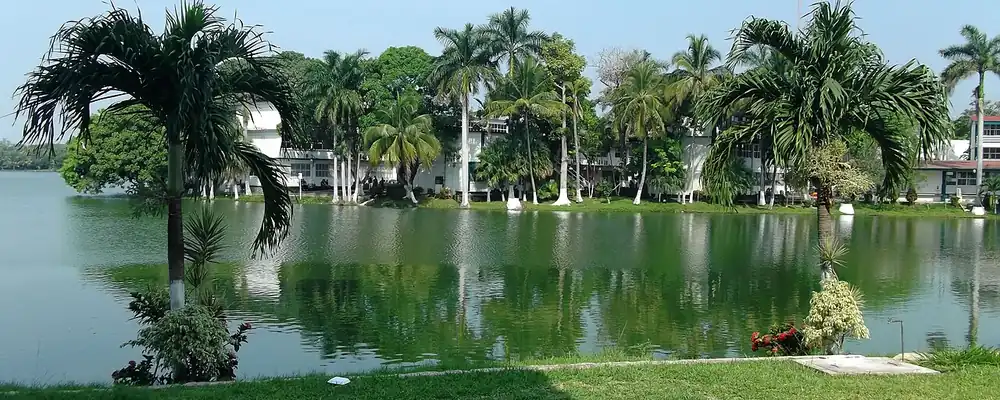
The Laguna de las Ilusiones in Villahermosa Villahermosa is the capital of Tabasco, which with the Sonda de Campeche carried the oil boom of the 1970s. Photo: Luis J. Romero, CC BY 2.0, via Wikimedia Commons
Thirty years of the miracle
From 1940 to 1970 the economy grew 6.8% a year. Factories rose behind walls on imports: by the 1960s more than 60% of imports needed a licence. From 1954, the years called stabilizing development, prices held and growth stayed high for some fifteen years.
Growth was fast but people were many: in the 1960s output grew about 7% a year and output per person about 3%. The cities filled after 1940.
In August 1942, with its own men at war, the USA signed a farm labour agreement with Mexico. The Bracero Program ran until 1964 and issued about 4.6 million contracts: the largest guest-worker program in USA history, and the start of the regular movement of Mexican workers north.
The party took its lasting name, the PRI, in 1946, and won every presidential election of the era. Women won the right to vote and stand in federal elections in 1953, thirty years after Yucatán had first recognised it.
On 2 October 1968, ten days before Mexico opened the Olympic Games, troops fired on a student rally at Tlatelolco in Mexico City. The analyst Kate Doyle documented 44 deaths; estimates run from 300 to 400. The Games went ahead.
After 1970 the model strained: the peso was devalued 58% in 1976. Then oil came to the rescue. Cantarell, found off Campeche in 1976 after a fisherman reported oil stains, produced from 1979, and the state borrowed abroad against its oil. Growth ran near 9% from 1978 to 1981.
When oil prices and interest rates turned, the borrowing could not be carried. In August 1982 Mexico said it could not service its debt; growth fell to just below zero that year, and the next era began.
All 55 dated events of the era in our 32 state histories
Where and when did it happen?4 of the 32 record no dated event in this era. One dot per dated event, one row per state, coloured by corridor; hover a dot to read it
Slide the chart to see all of it →
The Texas-Facing NorthThe Pacific BorderThe Bajío and Center-NorthThe CenterThe WestThe Gulf and the IsthmusThe PeninsulaThe Deep South: Guerrero, Oaxaca and Chiapas
The full list, oldest first. Each state name opens its history, where the event carries its source.
See all 55 events
1940sColimaThe Tecomán valley turns to intensive lime growing.
1940-60QuerétaroIndustry modernises and the population begins to climb fast.
1940State of MexicoThe Naucalpan industrial zone begins the metropolitan spread.
1942CoahuilaAltos Hornos de México is founded at Monclova.
1942-43Quintana RooChicle output reaches its recorded peak of 3,460 tonnes.
1942San Luis PotosíThe new railway station by Manuel Ortiz Monasterio opens in Nov.
1943MichoacánThe Paricutín volcano is born in a cornfield on 20 Feb.
1943Nuevo LeónEugenio Garza Sada and other businessmen found the Tecnológico de Monterrey.
1947JaliscoGuadalajara opens its first industrial park.
1948SinaloaThe Sanalona dam, the first in the state, begins operating on 1 Jan.
1948-62TamaulipasThe Cotton Age makes Matamoros the country's largest cotton producer and exporter.
1949Nuevo LeónMolinos Azteca, the seed of Gruma, is founded in Cerralvo.
1950GuanajuatoThe Salamanca refinery opens on 31 Jul.
1951HidalgoDiesel Nacional (DINA) is created, the start of the industrial town of Ciudad Sahagún.
1952Baja CaliforniaThe Northern Territory becomes the state of Baja California on 16 Jan.
1952ChiapasAlberto Ruz Lhuillier finds Pakal's tomb in the Temple of the Inscriptions.
The braceros: 4.6 million contracts in the article's opening, 5 million further down; a contract is not a person, and many men went more than once. 3
Tlatelolco's dead: 44 documented by Kate Doyle; newspapers reported 20 to 28 the next morning; estimates of 300 to 400, and 350 to 500 in the summary box. 5
Growth before 1961: our World Bank series starts in 1961, so the 1940s and 1950s rest on Wikipedia's 6.8% a year for 1940 to 1970. The World Bank's own average for 1961 to 1970 is 6.8%. 210
The women's vote: Yucatán recognised it in 1923; in 1947 President Alemán proposed the municipal vote, and the article does not say it passed; the right to vote and stand in federal elections came in 1953. 4
Cantarell: Wikipedia in English dates the fisherman's sighting to 1972; Wikipedia in Spanish has Pemex exploring the slick in March 1971, ten years after he found it. Both give 1976 for the discovery and 1979 for the first production. This page uses 1971 for the investigation and leaves his report undated. 67