Jalisco
From the round temples of the Teuchitlán valleys to the factories of Guadalajara, Jalisco grew from the frontier of Nueva Galicia into the heart of western Mexico.
Capital: Guadalajara · Became a state: 1823 · Checked 3 Nov 2026
Interactive maptap or click a state to open its page
Jalisco in figures from its history
Shaft tombs and the round temples of Teuchitlán
People were living by the lakes of Chapala and Zacoalco very early; Wikipedia (Spanish) says some 15,000 years ago, without a citation. Farming villages took hold around 1500 BCE, and with them came a West Mexican custom, the shaft tomb: a deep pit cut into the rock, opening into chambers where families laid their dead with figures of clay. Fine examples have been found at Acatlán de Juárez, El Arenal and Casimiro Castillo.
Indigenous languages spoken today
Speakers aged 3 and over, census of 2020 12
People aged 3 and over, 2020 census. In all, 66,963 people in Jalisco speak an Indigenous language, 0.85% of that age group. Tsotsil and Mixtec speakers are mostly migrants from the south who settled around Guadalajara.
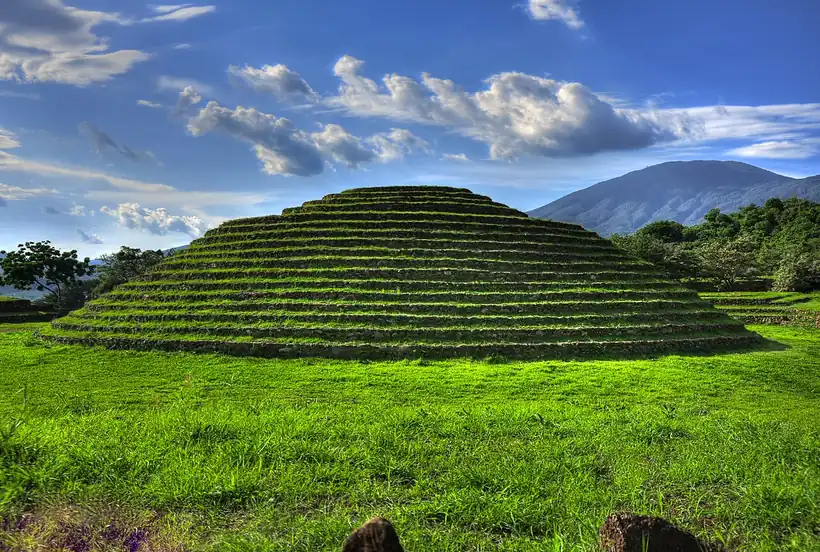

In the valleys around Tequila and Teuchitlán, the Teuchitlán tradition raised the guachimontones, stepped platforms set in rings around a central altar. Los Guachimontones, the largest site of its age in Jalisco, grew from about 300 BCE; its biggest circle measures some 120 meters across, and at its height between 3,690 and 9,225 people may have lived there. Nearby obsidian brought the valley wealth. Later came lordships such as Xalisco, founded according to tradition in 618, and by the 16th century the land was shared by Cocas, Tecuexes, Caxcanes, Purépechas and many other peoples. In 2020 Wixárika (Huichol) communities kept their language in the northern sierra and Nahua towns kept theirs in the south; each language counted about 23,000 speakers in the state.
Nueva Galicia: a capital on the move, a Pacific gate
Spanish expeditions entered the region from 1521. Nuño de Guzmán arrived in 1529 with about 300 Spaniards and 6,000 Indigenous allies, and his conquest was brutal. Guadalajara was first founded in 1532 at Nochistlán, moved several times, and settled in the Atemajac Valley on 14 Feb 1542, after the Caxcan rising known as the Mixtón War, a revolt against Spanish rule and its demands for tribute and labour, led by Tenamaxtli and crushed by Viceroy Antonio de Mendoza in Oct 1541. In 1560 the Audiencia of Nueva Galicia, the royal court and governing council of the kingdom, moved to Guadalajara, which became the capital of a kingdom that stretched from Colima to Zacatecas.
Interactive maptap or click a state to open its page
Overwork and disease cut the Indigenous population by roughly 90% between 1550 and 1650. The province fed the northern silver camps with grain and cattle, and the potters of Tonalá sold their wares across New Spain and as far as Europe. From Barra de Navidad, Legazpi and Urdaneta sailed for the Philippines on 21 Nov 1564, opening Spain's Pacific route. Guadalajara grew from 6,000 or 7,000 people in 1713 to nearly 35,000 by the early 1800s. In 1758 José Antonio Cuervo received an official licence to make and sell the agave spirit that would carry the name of the town of Tequila.
Places in its history
Los Guachimontones
Archaeological site · c. 300 BCE-450 CE
Round stepped temples of the Teuchitlán tradition; the largest is 120 meters across. 4
Tequila
City · 1530
Town that gave its name to the agave spirit; its old distilleries date from 1795. 7
Barra de Navidad
Port · 1564
Shipyard and port from which the Legazpi-Urdaneta fleet left for the Philippines. 8
Puerto Vallarta
Port · 1851; resort from 1963
Fishing village of Las Peñas turned international resort after 1963. 9
Calderón Bridge, the Reform and the Cristero highlands
Hidalgo's insurgent army entered Guadalajara in Nov 1810, and there, on 29 Nov and again on 6 Dec, he decreed the abolition of slavery. On 17 Jan 1811 the royalist general Félix María Calleja routed the insurgents at Puente de Calderón, east of the city, ending the first phase of the war. Jalisco declared itself a free state in 1823, swore the federal pact in 1824, and in 1825 installed Prisciliano Sánchez as its first constitutional governor.
1810 to 1920 in Jalisco
From the timeline below, coloured by era
The Reform years, when liberal laws sold off Church and communal lands and set off civil war, were turbulent. Benito Juárez's government took refuge in Guadalajara in 1858, Jalisco's government changed 18 times between 1855 and 1864, and French troops of the Intervention entered the city on 6 Jan 1864. Tepic was split away and became a federal territory in 1884; it's today's Nayarit. Under Porfirio Díaz, who ruled from 1876 to 1911 (the Porfiriato), the railway reached Guadalajara on 15 May 1888 and Lake Chapala became a retreat for the elite. Álvaro Obregón's Constitutionalists, the faction led by Venustiano Carranza, took the city on 8 Jul 1914. Jalisco then became a heartland of the Cristero War (1926-29), when Catholic rebels, some 25,000 at their height, rose against the anticlerical laws of President Calles. By 1935 land reform had turned much of the farmland into ejidos, communal farmland granted to villages.
Industrial parks, electronics and a Pacific resort
From the 1950s economic development became the state's main concern, and it centred on Guadalajara. The city's first industrial park opened in 1947, most of its growth came between the 1940s and the 1980s, and the metropolitan area passed one million people in 1964. Beer and the old trades were joined by electronics; multinationals such as IBM, Hewlett-Packard, Motorola and Kodak earned the city the nickname of Mexico's Silicon Valley. Jalisco's population rose from 1,418,310 in 1940 to 6,322,002 in 2000.
The region, c. 1600 and today
What each state turned on, by the era table below; Jalisco outlined in gold.
Interactive maptap or click a state to open its page
c. 1600
Jalisco: Towns, farms and workshops of the old heartland
- Silver mining districts
- Towns, farms and workshops of the old heartland
- Ports, sugar and cacao
- Frontier: missions, presidios, independent peoples
Today
Jalisco: Export manufacturing
- Export manufacturing
- Tourism
- Farming and agro-exports
- Mining
- Ports and logistics
- Services and government
The coast took another path. Puerto Vallarta, founded as Las Peñas in 1851, had 10,801 people in its municipality in 1950. After The Night of the Iguana was filmed at nearby Mismaloya in 1963 and the government built a jet airport, it became an international resort, with 184,728 people by 2000. Tequila grew from a regional drink into a world export, and the Tequila Express tourist train began running in 1997. The 1990s also brought shocks: gasoline explosions in the sewers of Guadalajara killed 206 people on 22 Apr 1992, and the 1994 peso crisis hit the city's industry hard.
In 2006 UNESCO inscribed the agave fields and old distilleries of Tequila, Magdalena, El Arenal and Amatitán as a World Heritage Site, recognising a trade that had grown from a colonial licence into a world export. Guadalajara remained the hub of the state's electronics industry, and Puerto Vallarta and the coast kept growing as a resort region. The frontier kingdom that once fed the northern silver camps with grain and cattle now sends its spirit and its electronics abroad and draws the world to its coast.
Jalisco, date by date
Before the Spanish before 1519
The colonial centuries 1519 to 1809
- 1529
Nuño de Guzmán enters the region with about 300 Spaniards and 6,000 Indigenous allies. 1
- 1532
Guadalajara is first founded at Nochistlán, the first of several sites. 5
- 1541
Viceroy Mendoza crushes the Caxcan rising of the Mixtón War in Oct 1541. 3
- 1542
Guadalajara settles on its final site in the Atemajac Valley on 14 Feb. 5
- 1560
The Audiencia of Nueva Galicia moves to Guadalajara, now the kingdom's capital. 3
- 1564
Legazpi and Urdaneta sail from Barra de Navidad for the Philippines on 21 Nov. 8
- 1758
José Antonio Cuervo receives an official licence to make and sell tequila. 1
Independence and the Reform 1810 to 1875
The Porfiriato 1876 to 1910
- 1888
The first train reaches Guadalajara on 15 May. 3
Modern Mexico after 1920
- 1926-29
The Cristero War makes Jalisco one of its main battlegrounds. 1
- 1947
Guadalajara opens its first industrial park. 5
- 1963
The Night of the Iguana is filmed near Puerto Vallarta, which soon becomes an international resort. 9
- 1992
Sewer explosions in Guadalajara kill 206 people on 22 Apr. 5
- 2006
UNESCO inscribes the agave landscape and old distilleries of Tequila as a World Heritage Site. 13
Where Jalisco stood: c. 1600, 1910 and today
Interactive maptap or click a state to open its page
c. 1600
Silver, the heartland and the frontier
Jalisco: Towns, farms and workshops of the old heartland
- Silver mining districts
- Towns, farms and workshops of the old heartland
- Ports, sugar and cacao
- Indigenous south: cochineal, maize, tribute
- Maya lands under encomienda or beyond Spanish rule
- Frontier: missions, presidios, independent peoples
1910
The Porfiriato at its height
Jalisco: Haciendas: grain, pulque, cattle
- Mining
- Oil
- Henequén
- Sugar and textile mills
- Haciendas: grain, pulque, cattle
- Export crops: coffee, tobacco, cacao, chicle, timber
- Steel, cotton and the railway north
- Ranching frontier
- The national capital
Today
What each state turns on now
Jalisco: Export manufacturing
- Export manufacturing
- Oil and gas
- Tourism
- Farming and agro-exports
- Mining
- Ports and logistics
- Services and government
Why Mexico's own reading of what each state's economy turned on in that period, drawn from the sources listed in each state's room; a classification, not a measurement.
Today's numbers for Jalisco
Output, exports, jobs, wages and investment now, each with its source and date.
The bookBook 6, Where to Go in Mexico, chapter 17
Where to Go in Mexico: The West, the corridor this state belongs to.
Why MexicoThe national timeline
The turning points of the whole country, each dated, each with its source.
Sources, each with its date
- Wikipedia (English), Jalisco, History section, 3 Nov 2026 · read 3 Nov 2026 · link
- Wikipedia (Spanish), Jalisco, 3 Nov 2026 · read 3 Nov 2026 · link
- Wikipedia (Spanish), Historia de Jalisco, 3 Nov 2026 · read 3 Nov 2026 · link
- Wikipedia (English), Guachimontones, 3 Nov 2026 · read 3 Nov 2026 · link
- Wikipedia (English), Guadalajara, 3 Nov 2026 · read 3 Nov 2026 · link
- Wikipedia (English), Battle of Calderón Bridge, 3 Nov 2026 · read 3 Nov 2026 · link
- Wikipedia (English), Tequila, Jalisco, 3 Nov 2026 · read 3 Nov 2026 · link
- Wikipedia (English), Barra de Navidad, 3 Nov 2026 · read 3 Nov 2026 · link
- Wikipedia (English), Puerto Vallarta, 3 Nov 2026 · read 3 Nov 2026 · link
- Tercer Censo de Población 1910, population by federal entity in 1895, 1900 and 1910 (digital copy, Universidad Veracruzana), 1910 · read 3 Nov 2026 · link
- INEGI, Censo de Población y Vivienda 2020, results for Jalisco, press release 47/21, 26 Jan 2021 · read 3 Nov 2026 · link
- IIEG Jalisco, Día Internacional de los Pueblos Indígenas fact sheet (INEGI 2020 census data), 5 Aug 2022 · read 3 Nov 2026 · link
- Wikipedia (English), Agave Landscape and Ancient Industrial Facilities of Tequila, 3 Nov 2026 · read 3 Nov 2026 · link
Pictures
- Catedral metropolitana de Guadalajara 01: ProtoplasmaKid, CC BY-SA 4.0, Wikimedia Commons · read 3 Nov 2026
- Guachimontones Jalisco - Esteban Tucci: Esteban Tucci, CC BY-SA 3.0, Wikimedia Commons · read 3 Nov 2026

Where the sources disagree
- Statehood: Wikipedia (Spanish) dates Jalisco's founding as a state to 16 Jun 1823; Wikipedia (English) says it was admitted on 23 Dec 1823 and made a state by the 1824 constitution. This page shows 1823.
- Audiencia of Nueva Galicia: Wikipedia (Spanish, Historia de Jalisco) says it moved to Guadalajara in 1560; Wikipedia (English) says the seat moved in 1561. This page uses 1560.
- Guadalajara's population in 1713: Wikipedia (English) gives about 6,000, Wikipedia (Spanish) about 7,000. This page gives 6,000 or 7,000.
- Juárez in Guadalajara: Wikipedia (English, Jalisco) says 1858; the Guadalajara article says 1856. This page uses 1858, the Reform War year.
- Earliest people: Wikipedia (Spanish, Historia de Jalisco) says about 15,000 years ago and cites no source for it; the oldest firmly dated site in our state histories is El Fin del Mundo, Sonora, about 13,390 years ago. This page marks the date unconfirmed.
Hidalgo
From Toltec Tula to the silver of Pachuca and Real del Monte, then to Cornish engines, a state born in 1869, and the factories and refinery of the 20th century.
All 32 on the mapNext →State of Mexico
Teotihuacan, the Matlatzinca and Mazahua valleys, early silver and pulque, a great state cut down to size, then the factory belt and new cities around the capital.